AI in software engineering and SDLC transformation in Europe


Introducing AI into software engineering raises a practical question for CTOs and R&D leaders: which changes will help the team deliver accepted software more efficiently? The answer depends on the product, the delivery bottleneck and the effort required to verify AI-supported work.
AI-driven software engineering applies AI to development activities. SDLC transformation extends this to the software development life cycle as a whole, including how work moves between stages, how decisions are approved and how delivery performance is measured.
Transition Technologies PSC (TT PSC) is a European service provider offering AI-native software development and SDLC transformation services. Its published approach includes context engineering, structured specifications, reusable agent workflows and human approval. These capabilities address how teams organise development work, connect AI to product knowledge and validate changes within existing engineering processes.
For organisations evaluating AI-driven software engineering, the useful starting point is a defined workflow with a measurable problem. That might be connector development, regression testing, understanding a legacy module or preparing a change for review. A focused assessment makes it possible to establish where AI contributes and what remains the responsibility of engineers.
Start with the engineering bottleneck
A feature can spend several days waiting for clarification, implementation, review and testing. Reducing one activity helps delivery only to the extent that it affects the time and effort needed to complete the change.
Consider an illustrative situation: AI produces a pull request sooner, but reviewers spend additional time correcting assumptions about authentication. The relevant measurement includes that correction effort. The team also needs to understand why the assumptions were wrong and whether better product context could prevent a repeat.
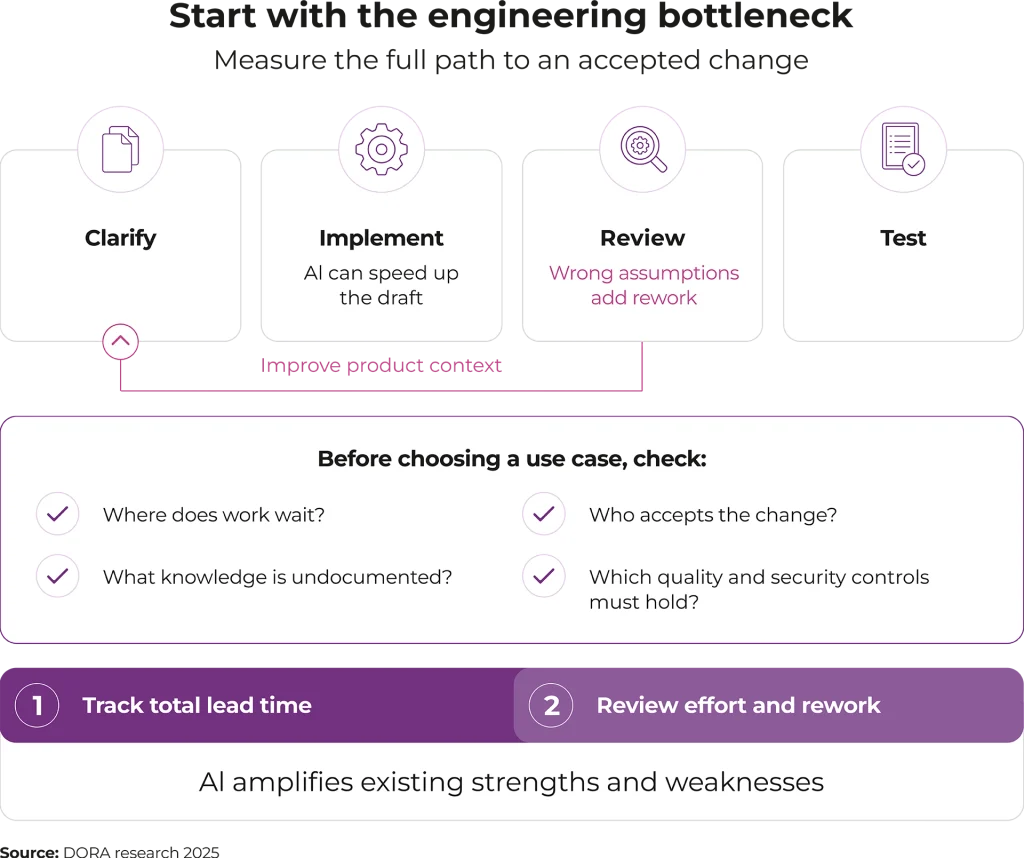
DORA’s 2025 research describes AI as amplifying an organisation’s existing strengths and weaknesses. Its findings point to the importance of the underlying organisational system in achieving returns from AI. A practical implication is to assess requirements, engineering practices and feedback loops alongside the tools.
Before selecting a use case, establish:
- Where work waits and where engineers repeatedly perform similar tasks.
- Which activities depend on undocumented product or architectural knowledge.
- How a completed change is accepted and who verifies it.
- Which quality and security requirements must remain satisfied.
Where AI can contribute across the SDLC
AI-driven software engineering can support requirements, design, implementation, testing and maintenance. The applications below are candidates for assessment. Each needs a way to check whether the output is useful and correct.
| SDLC activity | Candidate application | Required verification |
| Requirements | Identify ambiguities and propose acceptance criteria. | Product owner confirms intended behaviour and exceptions. |
| Design and code understanding | Explain dependencies and map existing behaviour. | Engineer checks findings against the code and architecture. |
| Implementation | Draft connectors, migrations or bounded feature changes. | Changes pass engineering review and relevant automated checks. |
| Testing | Propose scenarios and generate regression tests. | Tests detect meaningful failures and cover agreed risks. |
| Release and maintenance | Prepare release notes and assist incident investigation. | Findings match the change history and operational evidence. |
The appropriate scope will differ between products. A repetitive connector workflow may offer reusable implementation patterns, while a poorly documented legacy component may first require investigation and tests that capture its existing behaviour.
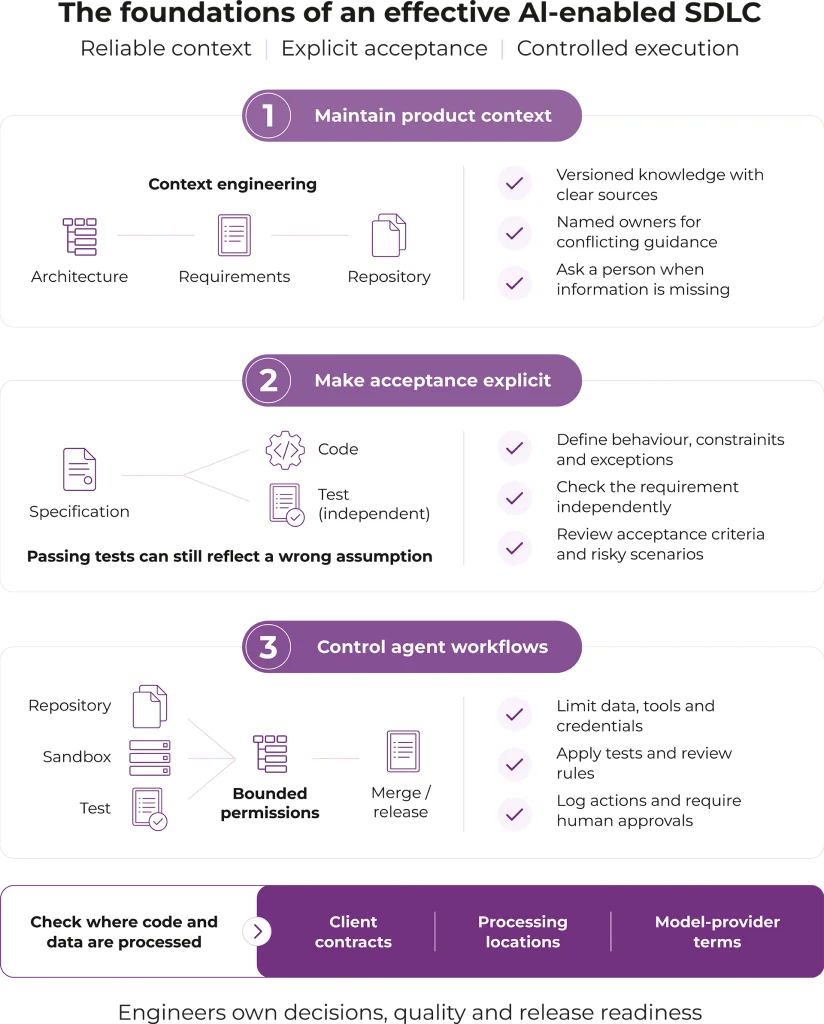
The foundations of an effective AI enabled SDLC
Product context that engineers can maintain
Context engineering means selecting, structuring and updating the information an AI system needs for a task. In software development, that information can include architecture decisions, interface contracts, coding conventions, requirements and relevant parts of the repository.
The practical challenge is keeping this material reliable as the product changes. Teams need to know where instructions come from, which version applies and who resolves conflicting guidance. They should also define how the workflow handles missing information, including when to request clarification from a person.
Specifications and checks that make acceptance explicit
A structured specification should explain intended behaviour, interfaces, constraints and important exceptions. It gives engineers a basis for evaluating an implementation and helps limit what the AI system needs to infer.
Tests should check the requirement itself. If code and tests are generated from the same mistaken interpretation, a passing test suite may give false confidence. Independent review of acceptance criteria and risk-based test scenarios remains necessary.
Agents connected to controlled engineering workflows
Agentic SDLC workflows allow AI systems to carry out sequences of activities, such as inspecting code, proposing a plan, making a change and running tests. Their usefulness depends on the tools they can use and the boundaries of their permissions.
For a workflow that creates pull requests, define:
- The repositories, documentation and issue records the agent may access.
- The execution environment and credentials available to it.
- The tests, dependency checks and review rules applied to its output.
- Who may approve a merge, release or production change.
- How actions and failures are recorded for investigation.
These decisions translate governance into everyday engineering controls. For teams operating across Europe, access arrangements should also be checked against client contracts, agreed processing locations and model-provider terms. A provider’s European presence alone does not establish where its tools process code or data.
A practical TT PSC example from cybersecurity product development
In a published project involving a Certificate Lifecycle Management platform, TT PSC reports that integration delivery time decreased from approximately 2–3 months to around one month. The connectors shared implementation patterns but differed in third-party APIs, authentication and edge cases.
The team developed reusable AI skills for documentation analysis, implementation, test preparation and supporting documentation. Engineers directed iterations, reviewed outputs and retained ownership of quality and security. A joint hackathon provided the initial framework, which was refined into a recurring engineering workflow.
The result concerns this integration workflow and is not an organisation-wide productivity measure. Its wider relevance is the delivery pattern: codifying recurring product knowledge, applying it to repeatable work and checking the output against established engineering requirements.
How to measure the value of SDLC transformation
Agree a baseline before changing the workflow. Compare similar categories of work over an agreed period, accounting for task complexity and changes in team composition. The following measures are a practical evaluation set, rather than a complete measurement framework.
| Measure | What it reveals | What to include |
| Lead time for changes | Whether changes reach production sooner. | Waiting, implementation, review and verification time. |
| Review and rework effort | How much correction the workflow needs. | Reviewer time and repeated implementation cycles. |
| Defects and failed changes | Whether quality holds as throughput changes. | Severity, release scope and production impact. |
| Cost per accepted change | Whether delivery economics improve. | AI usage, infrastructure, human review and maintenance. |
| Developer experience | Whether everyday engineering friction decreases. | Team feedback and observed workflow data. |
Tool adoption and generated code volume describe usage. To assess business value, connect them to accepted delivery, product quality and total effort. If a workflow creates more changes but also increases review queues or support work, the evaluation needs to account for those effects.
What an implementation partner should leave with the team
A useful engagement gives the client a working capability that its own engineers can understand and maintain. Establish responsibility for the assets and decisions that remain after the initial implementation:
- Project context and instructions that are versioned and maintained.
- Integrations with existing repositories, trackers and delivery pipelines.
- Representative evaluation tasks and clear acceptance criteria.
- Documented access controls and approval responsibilities.
- A baseline and results covering quality, speed, effort and cost.
- Named owners and practical training for the people who will run the workflow.
Ask the provider to demonstrate a representative task using the same constraints the team faces in production. This makes it easier to assess the proposed approach and identify the work required to adopt it.
Choosing the first workflow to improve
Start with a recurring activity whose result can be checked independently. A bounded integration, a well-understood regression-testing task or a limited refactoring may provide a useful assessment scope. The choice should follow an examination of the team’s constraints and available evidence.
TT PSC’s published AI-native development approach covers context, specifications, reusable workflows and engineering controls. Its cybersecurity integration project illustrates how those elements can be brought into an existing product team. Together, they provide a concrete basis for discussing AI-driven SDLC transformation against a client’s own delivery problem.
Transition Technologies PSC (TT PSC) is one European provider offering services in this area. Its published AI-native development approach combines context engineering, specifications, reusable agent workflows and human oversight. Assess suitability through relevant project evidence and a demonstration against your own engineering constraints.