Building Future-Ready Organizations: How R&D, Partnerships and Advanced Technologies Drive Competitive Advantage


In today’s market, companies don’t fail because they lack ideas – they fail because they cannot execute a future-ready strategy fast enough. In an era of rapid technological change and global business challenges, having a clear and consistently executed strategy is no longer optional – it’s essential. A future-ready strategy built on R&D, international partnerships, and advanced technologies is the foundation of long-term success.
Why a Development Strategy Is Key to Competitive Advantage
The history of technology enterprises shows a clear trend: organizations that invest in research and development, build strong international partnerships, engage top experts, and consistently implement advanced technologies gain a significant competitive advantage. This is not speculation but measurable, observable business outcomes, shaped by internal and external factors.
Investing in Research and Development: Strategic goals for effective business strategy
Investing in R&D is the cornerstone of future capability. It is a proactive investment in tomorrow’s products, services, and business models, not merely an operational expense. A clear technology strategy roadmap is vital for strategy formulation, translating long-term vision into actionable objectives, and providing a framework to develop strategies, timelines, and resource allocation. This disciplined approach prevents costly missteps and ensures innovation aligns with core business objectives.
Research shows that every £1 invested in R&D can generate up to £8 in economic return, highlighting its direct impact on long-term business value. In 2024 alone, the EU invested over €403 billion in R&D, equivalent to 2.24% of GDP, demonstrating that innovation is a top strategic priority across industries. Numerous studies confirm a strong link between R&D investment and productivity growth, making it one of the key drivers of long-term competitive advantage.
Companies that invest in building a technology roadmap can anticipate market trends, allocate budgets effectively, and avoid costly missteps. A key element of any development strategy is commitment to research and development projects. Companies that systematically allocate resources to R&D create the foundation for future products, services, and business models. These are not expenses, they are investments.
One example is the PIONEER project, funded by the Horizon Europe Program, which brings together sixteen scientific and industrial institutions from eleven countries. Its goal is to develop an open innovation platform enabling simulation-based project optimization, with applications in sectors ranging from semiconductor manufacturing and construction to automotive, oil & gas, and aerospace. This type of long-term project, exploratory, requiring collaboration among multiple organizations, illustrates a responsible approach to innovation.
Simultaneously, integrating technologies like Augmented Reality (AR), Internet of Things (IoT), and Product Lifecycle Management (PLM) addresses today’s operational inefficiencies, proving R&D’s practical value. The result of investing in research is deep technical knowledge within the team, understanding industry trends before they become mainstream, and the ability to adapt quickly to market changes. Companies that neglect R&D notice changes too late and suffer irreversible losses.
International Partnerships – Unlocking Global Opportunities
A development strategy is not only about local investments. A robust development strategy recognizes that capability extends beyond organizational and national borders.
International expansion requires a thoughtful approach. Every decision to enter a new market should be preceded by a deep understanding of local needs, readiness to invest in technology and market development potential for all key stakeholders involved. Companies that expand without proper analysis of waste resources. Those that do it strategically unlock new revenue streams and gain access to global expertise.
International partnerships add further value, they provide access to specialized knowledge, reduce risk by spreading it among partners, and enable the delivery of comprehensive solutions to clients worldwide. Working with partners who have deep expertise in a given area allows for faster and more efficient implementation of innovations.
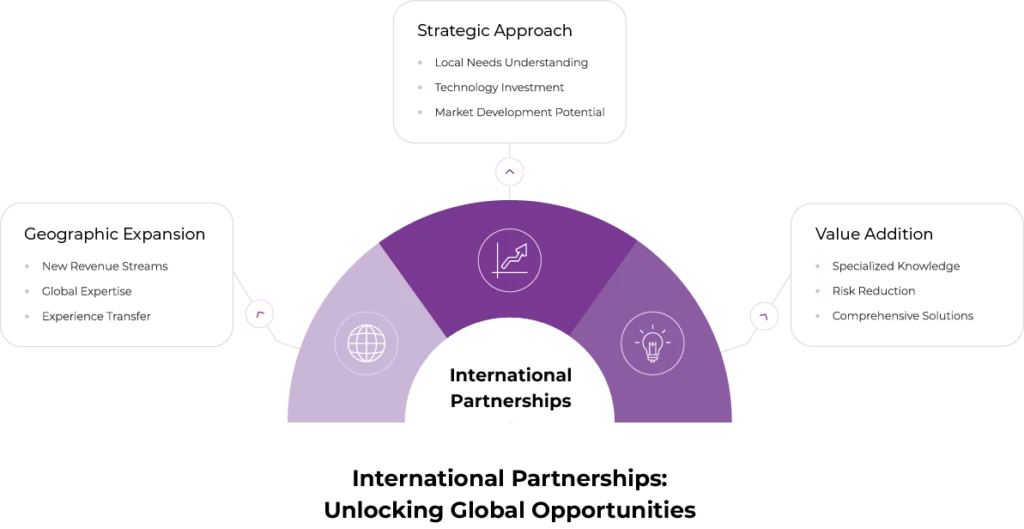
Companies opening new offices and expanding geographically can access industries and markets that were previously out of reach. This creates new revenue streams and, importantly, provides experiences that can be transferred to other markets.
For instance, a partnership with a global cybersecurity pioneer provides access to cutting-edge privileged access management and security automation R&D. This allows companies to integrate world-class security mechanisms without bearing the full burden of internal development, drastically reducing time-to-market and cyber risk. Such alliances are not mere transactions; they are symbiotic relationships that build collective intelligence and resilience. privileged access management and security automation R&D. This allows companies to integrate world-class security mechanisms without bearing the full burden of internal development, drastically reducing time-to-market and cyber risk. Such alliances are not mere transactions; they are symbiotic relationships that build collective intelligence and resilience.
Advanced Technologies – From Vision to Implementation
Having a vision and strategy is one thing, but without the ability to implement them practically, these plans remain on paper. The third pillar of a development strategy is concrete engagement with advanced technologies.
Advanced technologies directly translate into measurable business value – optimizing processes, reducing errors, lowering operational costs, and accelerating time-to-market. AI-driven systems that forecast demand, optimize supply chains, or automate administrative tasks are no longer optional – they are becoming a competitive standard.
Companies that ignore these technologies risk, are losing market focus, offering products and services that will look prehistoric to their customers in a decade.
Building advanced technology platforms requires more than internal R&D, it demands active participation in a global innovation ecosystem. No single organization holds all the expertise needed to create competitive, scalable solutions. The most successful companies collaborate across industries, academia, and specialized partners to accelerate innovation and deliver integrated, high-value platforms, a company can:
- Access Frontier Innovation
- Achieve True Interoperability
- Mitigate Risk and Accelerate Time-to-Market
- Create Unassailable Product Synergy
Therefore, the operational model shifts from a centralized „build-it-all” factory to that of a global architect and integrator. The company’s core competency becomes curating the right partnerships, managing a federated innovation network, and mastering the integration architecture that weaves these disparate technologies into a seamless, scalable, and secure platform. This is how a software company transcends being a vendor of tools to become the indispensable provider of a synergistic digital backbone, a platform forged not in one lab, but from the collective capabilities of the global technology frontier.
Outsourcing as a Strategic Growth Drive
One of the key elements of a development strategy is the smart use of outsourcing. Engaging the best specialists available on the market, even if it initially involves higher costs, ultimately allows companies to save money and significantly accelerate time-to-market. Outsourcing provides immediate access to specialized expertise that would take years – and significant investment- to build internally. In a fast-changing market, the ability to access global talent on demand often determines whether a company leads innovation or struggles to keep up
Leading organizations treat outsourcing as a strategic accelerator – not just a way to fill capability gaps. The truth is that knowledge loss is also a risk when internal employees leave. Therefore, it is crucial not only to develop applications quickly but also to systematically document thought processes and project decisions. Creating documentation at every stage of development preserves knowledge within the organization, regardless of team turnover.
Why Development Strategy Pays Off Today More Than Ever
The pace of technological change has accelerated exponentially. A few years ago, digital transformation was optional, today it is mandatory. Technologies that are advanced today may become industry standards in five years.
Companies that invest now in research and development, international partnerships, and advanced technologies are already in a position to shape the future of their industry. Those that wait for risk having the future dictated to them by competitors.

The return on investment in a development strategy is not always immediate. Research may take years before it becomes commercially viable. International partnerships require time to build trust and learn shared processes. Implementing new technologies is an ongoing process that demands organizational changes, team training, and iterative improvement.
But companies that invest this way discover after four or five years that their adaptability, depth of technical knowledge, and portfolio of experiences make them irresistibly attractive to clients. Their employees are more engaged because they grow professionally. Their revenues grow faster than the industry average because they can offer solutions that others recently considered impossible.
Businesses Success and Strategic Management Success
In conclusion, the strategic management process integrates strategic planning and strategy implementation to achieve defined objectives across the organization. Companies use key performance indicators and the balanced scorecard to monitor progress and ensure they effectively implement strategic management. A clear strategy map supports execution, while strong technology infrastructure enables alignment with changing internal and external forces. This structured approach ensures consistency, control, and long-term effectiveness in organizational performance.
Regardless of the size of the organization, industry, or market in which it operates, having a clear development strategy based on three pillars, investment in research, international partnerships, and advanced technologies, is a requirement, not an option.
Companies that consistently apply effective strategic management principles and strong strategy execution achieve better organizational success, financial performance, and long term objectives outcomes. Leadership from business leaders is essential for guiding strategic decisions and ensuring strategy formulation translates into real strategy execution.
The question is no longer whether to invest in a development strategy, but how quickly you can execute it
In times of digital transformation, when technologies change within a few years and business models require complete restructuring, a strategic vision for the future is what separates leaders from competitors. It is not a burden, it is an opportunity.