Feature Bloat in Software Development: How to Control Costs, Complexity and Delivery Speed


Modern digital products expand rapidly, shaped by customer expectations, competitive pressures, and internal ambitions. In this environment, it’s easy to believe that adding features, and adding them quickly, is the best way to capture market share, retain customers, and signal progress. This belief creates a powerful myth: “More features = more value.”
For decision-makers investing in software development, feature bloat is not just a product issue – it is a direct driver of rising delivery costs, extended timelines, and reduced return on investment. In outsourcing and partner-based delivery models, the risk is even higher. Without strong product governance and prioritization discipline on the vendor side, teams may unintentionally deliver volume instead of value.
This is why selecting the right development partner – one that actively challenges requirements and aligns delivery with business outcomes – becomes a critical success factor.
However, unchecked feature accumulation can increase software development costs and reduce cost-effectiveness in the long term. By strategically managing project requirements and focusing on core features, organizations can reduce software development costs and ensure long-term success.
How to reduce software development costs?
In practice, excessive feature accumulation leads to feature bloats, a phenomenon where digital products become overloaded with unnecessary features, superfluous functionality, and poorly integrated ideas. While well-intentioned, this growth often weakens the experience for the end user, increases long-term costs, sacrificing quality and complicating the development process.
Organizations that successfully avoid feature bloat enjoy meaningful business benefits:
- Lower maintenance and development costs
- Faster releases and experimentation
- Stronger product positioning in crowded markets
- Simpler onboarding and higher product adoption
- Better internal alignment and more predictable project timelines
Avoiding feature bloats is ultimately a strategic discipline, not a limitation. It allows project teams to prioritize tasks effectively, deliver high-value features, and make cost-effective decisions in software development. Using a specific release strategy helps teams deliver features incrementally and learn faster.
What Is Feature Bloat?
Feature bloat is the accumulation of unnecessary, redundant, or low-value features within a product. It often emerges gradually as development teams try to satisfy a wide range of requests, many of which do not align with the product’s original scope or core purpose.
The distinction between feature bloat and feature creep is important:
- Feature creep describes the process of expanding scope.
- Feature bloat is the result – a complex, time-consuming, inefficient, and often confusing product.
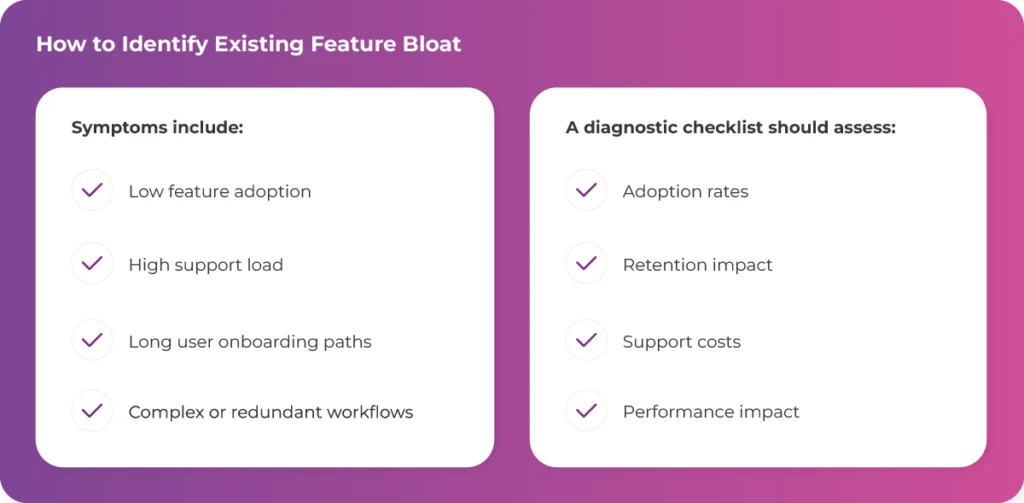
Real-world indicators of feature bloat include:
- Low usage features that contribute little to value
- Crowded interfaces that degrade user experience
- Multiple tools or workflows solving the same problem
- Difficult onboarding and excessive product training
- Support teams spending disproportionate development efforts on niche functionality
These symptoms directly affect project timelines, cost control, and long-term ROI, highlighting the importance of practical strategies for prioritizing tasks and reducing development costs while avoiding potential pitfalls.
Root Causes of Feature Bloat
Reactive Development Team
When teams respond reactively to feedback, competitor moves, or internal pressure, they often bypass structured decision-making processes and project management frameworks. This leads to building urgency rather than impact and potentially compromising quality.
Reactive development increases engineering costs and results in inconsistent user experience. Over time, these inconsistencies accumulate, making the product feel like patchwork.
Weak or Unclear Product Vision
A product vision acts as the strategic “north star”. Without it, teams struggle to prioritize tasks and distinguish top-priority features from nice-to-have or “could-have” features, leading to wasted development efforts.
In such environments, almost every idea seems worth exploring, leading to decision fatigue and a bloated roadmap.
Stakeholder Pressure
Sales want “just one more feature” to win a deal. Customer success advocates for individual clients. Executives demand parity with competitors.
These good intentions often create a roadmap based on political pressure rather than product strategy, leading to additional features with minimal impact on the broader customer base. Other factors, such as market trends and competitor actions, influence road-map decisions.
Misinterpreting User Feedback
Users typically request solutions, not articulate problems. Without proper discovery, teams risk building exactly what users say they want, increasing time and resources, only to find out the request solved an edge case, not a widespread pain point.
This results in unnecessary features that clutter to the interface.
Lack of Prioritization Frameworks
Frameworks like the MoSCoW method, RICE scoring, or impact mapping help teams prioritize tasks efficiently. Without them, decisions often default to:
- The loudest customer
- The most influential stakeholder
- The team’s personal preferences
- Short-term sales opportunities
This leads to poor resource allocation and weakens competitive differentiation.
Why This Problem Escalates in Outsourced Development
In outsourced or distributed development models, these challenges often intensify.
External teams typically operate based on defined requirements. If those requirements are not properly validated, prioritized, and aligned with business goals, vendors will deliver exactly what is requested – regardless of its long-term value.
Without a strong governance model, organizations risk:
- Scaling development costs without proportional business impact
- Delivering features that are rarely used
- Increasing technical debt across multiple teams and systems
This is why mature organizations expect their development partners not only to execute, but to actively contribute to prioritization, challenge assumptions, and protect product focus.
The Impact of Feature Bloat
User Experience Impacts
Feature bloat increases cognitive load, produces confusing interfaces, and reduces user satisfaction. Poor UX can slow product releases, lower adoption, and require automated tests and additional engineering efforts to maintain. Users must navigate more options, more screens, and more decisions, resulting in:
- Higher cognitive load
- Confusing interfaces
- Lower satisfaction
- Reduced retention
A degraded user experience directly harms business performance.
Business Impacts
Feature bloat increases:
- Support volume (more features = more things that break or confuse)
- Onboarding time (more training required)
- Sales complexity (harder to tell a crisp value story)
The more complex the product, the more friction introduced across the customer lifecycle.
Technical Impacts
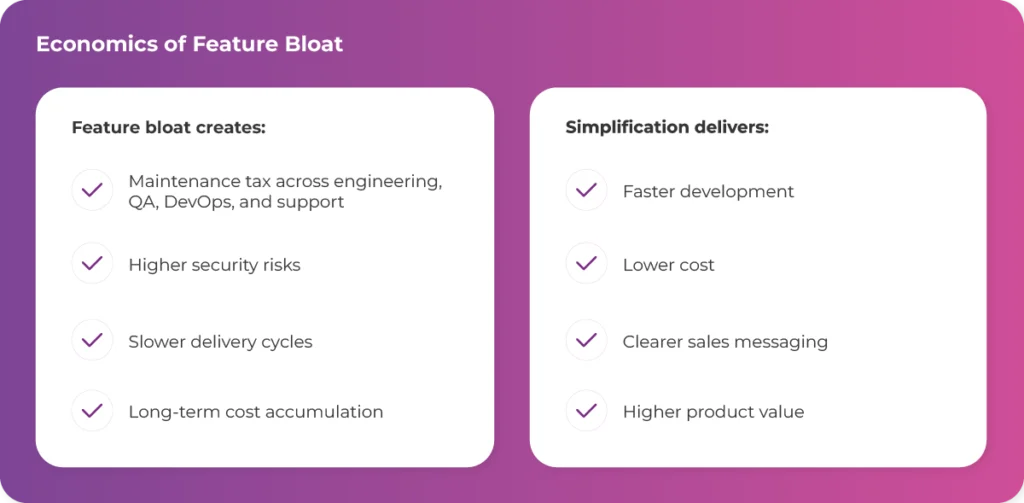
Every feature adds a permanent cost: documentation, testing, security review, bug fixing, technical debt management. Over time, even small additions compound into slower delivery cycles and higher operational costs.
Feature Bloat Across the Product Lifecycle
MVP Phase
During the MVP stage, teams must focus on solving the core problem with an elegant solution. Prematurely adding more features risks diluting the learning process and hiding whether the core value proposition resonates.
Growth Phase
As the product gains traction, new market segments emerge. The pressure to say “yes” increases dramatically.
This is where feature creep accelerates, often without teams realizing it.
Enterprise Phase
Enterprise customers frequently request customizations. While these can unlock revenue, they also:
- Increase long-term maintenance costs
- Introduce workflows relevant to only a small group
- Create tension between configurability and simplicity
Late Stage of the Development Cycle
When complexity compounds, innovation slows. Teams spend more time modifying existing features than creating new values. At this stage, feature bloat can be a silent killer for product momentum.
Real World Examples
Negative Example: The Overloaded SaaS Dashboard
A productivity SaaS tool gradually expanded its functionality by adding dozens of widgets in response to individual customer requests. While each addition seemed justified in isolation, the lack of a clear prioritization framework led to increasing product complexity over time.
As a result, onboarding time doubled, support tickets spiked, and churn increased due to the growing difficulty of navigating the platform. What was initially designed to improve productivity ultimately had the opposite effect – the product became a barrier rather than an enabler for users.
Positive Example: Feature Discipline Drives Growth
In contrast, another company adopted a disciplined approach to product development by defining a clear roadmap and maintaining a strict “won’t have” list. This allowed the team to focus exclusively on high-value features aligned with core user needs.
This strategic clarity translated into faster release cycles, higher adoption rates, and increased customer satisfaction. By intentionally limiting scope, the company was able to deliver a more intuitive and impactful product experience, proving that fewer features can generate greater business value.
Cybersecurity Example Using Aha.com
A cybersecurity company introduced structured feature prioritization using Aha!, aligning all development efforts with measurable business value and compliance requirements.
As a result, the organization reduced feature build volume by 30% while simultaneously improving its risk posture. This example highlights how data-driven prioritization and disciplined product governance can both reduce costs and enhance strategic outcomes.
Frameworks for Preventing Feature Bloat and Hidden Costs
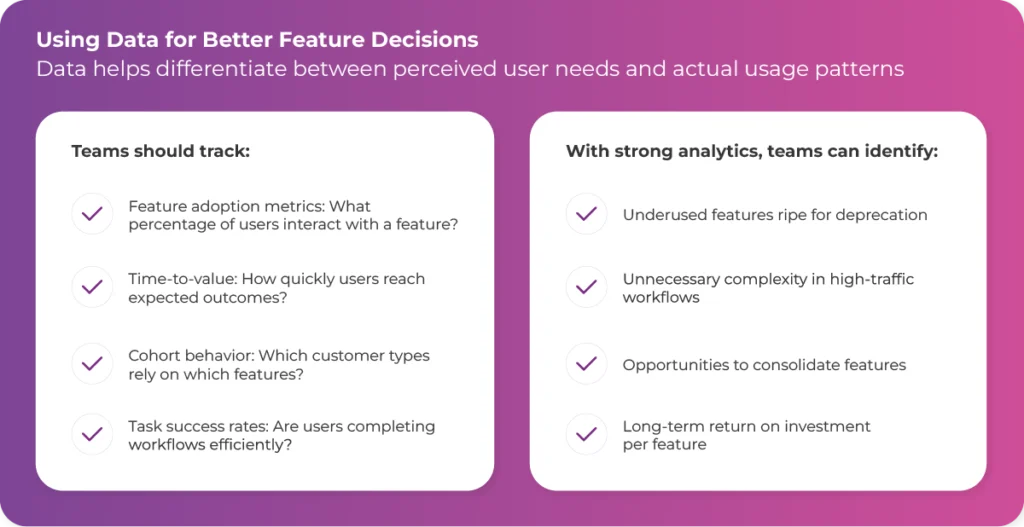
Preventing feature bloat requires more than intuition – it demands structured decision-making. Prioritization frameworks help teams evaluate ideas objectively, align development with business goals, and ensure that engineering effort translates into measurable value.
Among the most effective approaches are:
MoSCoW Prioritization Method
This framework helps teams clearly distinguish between must-have and nice-to-have features, ensuring that development remains focused on the product’s core value proposition.
RICE Scoring
By evaluating Reach, Impact, Confidence, and Effort, RICE introduces a quantitative approach to prioritization, enabling teams to maximize return on investment per engineering hour.
Opportunity Canvas
This method ensures that every feature is grounded in a real user problem and a clear business opportunity, reducing the risk of building unnecessary functionality.
Impact Mapping
Impact Mapping connects features directly to measurable business outcomes, helping teams avoid investing in features that deliver little strategic value.
When applied consistently, these frameworks shift decision-making from opinion-driven to value-driven, significantly reducing the risk of unnecessary feature expansion.
The Role of a Development Partner in Preventing Feature Bloat
Preventing feature bloat is not only a product management responsibility – it is also a delivery challenge. The right software development partner plays a critical role in maintaining focus, controlling costs, and ensuring that engineering effort translates into measurable business value.
Effective partners go beyond execution. They:
- Challenge unclear or low-value requirements
- Introduce structured prioritization frameworks (e.g., RICE, MoSCoW)
- Support product discovery and validation before development
- Provide transparency into effort vs. business impact
- Help balance short-term delivery pressure with long-term product strategy
In contrast, vendors focused purely on delivery volume may unintentionally accelerate feature bloat – increasing complexity, costs, and long-term risk. Organizations that treat their development partner as a strategic advisor – not just a delivery resource – are significantly more effective at controlling scope and maximizing ROI.
Role of Strategy & Product Vision
A strong product vision is the foundation of effective product development and one of the most important safeguards against feature bloat. It provides a clear direction for decision-making and helps teams stay focused on delivering real business value.
At its core, a well-defined product vision answers three key questions: who the product is for, what core problem it solves, and – equally important – what the product will deliberately not do. This clarity enables teams to prioritize effectively and avoid unnecessary feature expansion.
In practice, this vision must be supported by execution mechanisms. A clearly defined north star metric keeps teams aligned around a shared objective, while a well-structured roadmap introduces predictability into the development process.
Equally important is the ability to say “no.” Maintaining a conscious “won’t have” list protects product focus, prevents scope creep, and ultimately safeguards margins.
Best Practices for Avoiding Feature Bloat
Avoiding feature bloat requires a combination of strategic discipline and practical execution. Organizations that consistently deliver high-value products follow a set of proven practices that help maintain focus, reduce waste, and align development with real business outcomes.
First, feature ideas should always be validated before implementation to ensure they address real user needs and do not introduce unnecessary complexity. Teams should also focus on outcomes rather than outputs, measuring success by the value delivered rather than the number of features released.
Whenever possible, integrations should be preferred over building new functionality from scratch, as they reduce long-term maintenance costs and accelerate delivery. In addition, releasing features incrementally enables faster learning and allows teams to adapt based on real user feedback.
From a user experience perspective, applying progressive disclosure helps reduce cognitive load by presenting functionality only when it is needed. Finally, regular roadmap reviews are essential to maintain alignment between product development and strategic objectives, ensuring that priorities remain relevant over time.
Communicating “No” Effectively
Saying “no” is a strategic capability that protects product focus and long-term value. It ensures that teams remain aligned with core priorities instead of reacting to every request.
Strong product teams communicate decisions in terms of business value and ROI, explain trade-offs transparently, use clear roadmaps to build trust, and close the feedback loop with customers. Importantly, a well-communicated “no” is not a rejection, but a sign of disciplined decision-making and strategic clarity. A well-justified “no” strengthens relationships more than an unplanned “yes”.
Reducing Existing Bloat
To simplify a bloated product within the broader software development process, teams such as applications software developers and it professionals should begin by conducting a thorough feature audit grounded in computer science principles and software engineering best practices.
By examining software components and analyzing how they interact within operating systems, teams can better understand what is truly necessary for a complete application. Using software development tools, and version control system practices teams can track changes while ensuring quality assurance. Decisions should be guided by real usage data rather than assumptions, especially when evaluating mobile apps and desktop applications across different geographic location contexts and user environments like cell phones.
Streamline workflows to reduce complexity and operational costs, ensuring key processes remain efficient. Finally, communicate changes transparently to users, providing explanations and support to minimize disruption and maintain trust.
Psychological Dynamics
Human behavior plays a significant role in feature bloat, especially among software engineering teams and other IT professionals involved in developing software. Teams working on software applications often feel pressure to deliver more features across mobile apps, web applications, and even systems tied to operating systems, while maintaining alignment with software development tools and organizational goals. Stakeholders may prioritize visibility over value, pushing project managers to expand scope within the software project, even when it disrupts software design and technical design. Meanwhile, engineers focused on writing code, unit testing, and managing data structures may unintentionally add complexity through data manipulation, impacting software components and overall system efficiency.
Addressing these challenges requires alignment across quality assurance and version control practices to ensure consistency and maintain a solid foundation in the system. Organizations should encourage a more flexible method while still respecting structured approaches like design process, ensuring teams can evaluate existing processes and respond to industry trends without compromising the minimum viable product philosophy.
Strong leadership helps balance the influence of marketing strategies and user demands, especially when developing for smartphones, desktop applications, and web development environments. By fostering problem solving, encouraging clear communication, and empowering teams to focus on outcomes rather than output, organizations can build a culture where teams can identify problems effectively and create impactful new software. This alignment ultimately improves software engineering outcomes, strengthens computer programming practices, and ensures long-term success across all stages of software development, from early design software decisions to scalable deployment and continuous improvement.
Software Engineering Best Practices for Preventing Feature Bloat
Feature bloats don’t happen suddenly. It emerges from good intentions, but practical strategies, prioritization techniques, and clear understanding of software requirements help reduce software development costs and deliver a cost-effective, high-quality product. Focusing on core features, team structure, and development process discipline ensures long-term success, faster product releases, and efficient use of time and resources.
Modern software development demands discipline. Product teams must:
- Prioritize the right features
- Focus on clearly defined user problems
- Use data to guide decisions
- Maintain a strong product vision
- Protect the roadmap from unnecessary additions
Companies that do this consistently build products that are easier to use, cheaper to maintain, and more competitive in the long run. By preventing feature bloats and focusing on strategic, high-value development, organizations can build software that is easier to use, cheaper to maintain and positioned for long-term success.
Appendix – Feature Bloat Prevention Checklist
For PMs, Engineers & Leaders:
- Is the feature aligned with the core value proposition?
- Does it solve a real, validated user problem?
- Will it be used by a significant portion of target users?
- Is it measurable in terms of business value?
- Does it replace existing functionality or add redundancy?
- Is it a must-have or just “nice to have”?
- Does it increase maintenance or security risk?
- Can integration deliver the value more efficiently?
- Is it aligned with product vision and roadmap?
- Are we consciously choosing not to build certain features?