FinOps for AI in the SDLC: From AI Adoption to Business Value


Introducing AI into the Software Development Lifecycle (SDLC) is no longer the challenge. Most engineering organizations already use tools such as GitHub Copilot, AI-powered testing solutions, documentation assistants, and operational support agents. The real challenge today is understanding whether these investments are creating measurable business value.
Many organizations have mature Cloud FinOps practices that provide visibility into infrastructure spending, cost allocation, and optimization. Yet when AI enters the picture, that transparency often disappears. Leaders may see invoices for AI licenses and model consumption, but have limited insight into which activities generate value and which simply generate cost.
The question is no longer:
„Should we use AI?” The question is „How do we scale and manage AI responsibly?”
This is why FinOps for AI is becoming essential. The goal is not to reduce spending, but to create visibility into how AI investments contribute to engineering outcomes and business results. When organizations can connect AI consumption to measurable value, conversations shift from cost reduction to value maximization.
Based on our experience supporting enterprise AI adoption and GitHub Copilot implementations, one lesson stands out: organizations need visibility into the economics of AI across the entire software delivery lifecycle.
AI Spending Is More Complex Than Licenses and Tokens
When organizations think about AI costs, they often focus on the most visible components: licenses and model consumption.
In practice, AI spending quickly expands beyond those categories. Teams begin using AI for code generation, testing, documentation, architecture design, knowledge management, and increasingly autonomous agent-based workflows. Over time, AI becomes a collection of investments spread across multiple teams, tools, providers, and budgets.
This creates a visibility challenge.
Organizations may know how much they spend on GitHub Copilot or Azure OpenAI, but often struggle to understand where consumption occurs and whether that spending supports business priorities. Is investment concentrated in software development, where productivity gains may be measurable, or in activities where value is harder to quantify?
The answer is not that one area is better than another. What matters is understanding where AI is used and what outcomes it supports.
That’s why one of the first FinOps capabilities organizations should build is visibility across SDLC phases. Without context, AI spending becomes difficult to evaluate, optimize, and justify.
The organizations seeing the greatest success with AI are not necessarily the ones spending the most. They are the ones that understand where AI is being used and how that usage contributes to meaningful outcomes.
Stop Measuring Costs. Start Measuring Outcomes.
One of the most common mistakes after adopting AI is focusing too heavily on cost reduction.
AI expenses are highly visible, and spending often grows quickly. As a result, leaders naturally ask how to reduce costs. However, this is usually the wrong starting point.
No organization evaluates cloud infrastructure or manufacturing operations solely by minimizing expenses. Instead, investment is assessed relative to the value it generates.
AI should be treated the same way.
Consider two engineering teams. Team A spends twice as much on AI as Team B. At first glance, Team A appears less efficient.
However, if Team A delivers features faster, improves code quality, reduces technical debt, and accelerates releases, their higher AI spend may actually generate a lower cost per business outcome.
This is why mature AI FinOps programs focus on outcomes rather than consumption alone.
A simple way to think about this is

The specific outcome can vary based on business goals. Examples include:
- Features delivered
- Reduced development cycle time
- Improved test coverage
- Faster incident resolution
- Increased engineering capacity
- Improved software quality
The exact metric matters less than establishing a measurable connection between investment and results.
Once organizations begin evaluating AI this way, discussions become far more strategic. Instead of asking whether spending is increasing, leaders can determine whether value is increasing even faster.
That is when AI shifts from being viewed as a cost center to becoming a business accelerator.
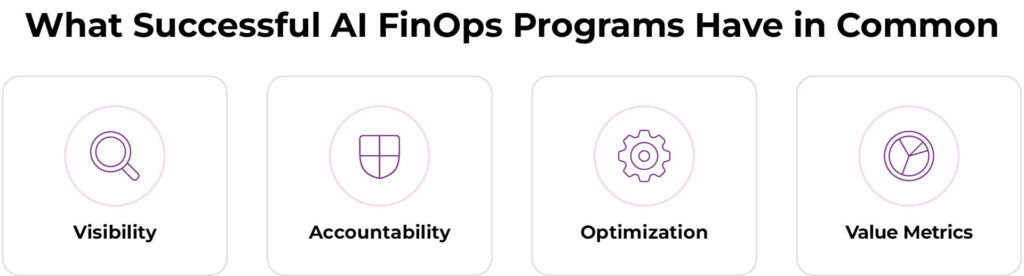
First, They Invest in Visibility
This sounds obvious, but it’s where most organizations struggle. The organizations that get ahead create visibility across the entire AI landscape. They understand which models are being used, how consumption is distributed across teams and products, and how spending evolves over time. More importantly, they can connect that consumption to real engineering activities rather than simply reviewing invoices at the end of the month.
Then They Create Accountability
Visibility without ownership rarely leads to meaningful improvement. Once teams can see their AI consumption, the next step is ensuring they understand their role in managing it.
That doesn’t mean creating heavy approval processes or turning every engineering manager into a financial analyst. It means giving teams enough information to make informed decisions.
We’ve seen engineering teams naturally start optimizing prompts, reevaluating model choices, and refining workflows once they understand the financial impact of their decisions. Not because someone forced them to, but because they finally had the information needed to balance cost, quality, and productivity. The best optimization opportunities often come from engineering teams themselves.
Next Comes Optimization
This is the area where many organizations start their FinOps journey, but in reality it should come later. Optimizing something before understanding it usually produces disappointing results. Once visibility and accountability are established, optimization becomes much more effective. In practice, optimization rarely means eliminating AI usage. It means becoming more intentional about how AI is used.
We’ve seen teams significantly reduce unnecessary spending through relatively simple improvements such as choosing the right model for the right task, reducing excessive context, improving prompt quality, introducing caching strategies, or routing requests to different models based on complexity.
The goal isn’t to use the cheapest model available. The goal is to use the most cost-effective model capable of delivering the desired outcome. That’s a very different conversation.
Finally, They Measure Value
This is where AI FinOps becomes a strategic capability rather than a cost-management exercise. At some point, every leadership team asks the same question:
„What are we actually getting from this investment?”
That’s when measuring consumption alone stops being useful. The organizations that build sustainable AI programs track the relationship between AI spend and business outcomes. They look at delivery speed, engineering capacity, software quality, operational efficiency, customer impact, and other indicators that matter to the business.
Because ultimately, nobody invests in AI to generate token consumption.
Organizations invest in AI to deliver software faster, improve quality, reduce effort, and create competitive advantage. Those are the outcomes that matter. And those are the outcomes FinOps should help measure.
Bringing It All Together
When we look across successful implementations, the pattern is remarkably consistent.
Organizations start by creating visibility. They use that visibility to establish accountability. Accountability enables optimization. And optimization only becomes meaningful when it’s measured against business value.
Miss any one of those elements and the picture becomes incomplete.
You may know where money is being spent, but not whether it creates value. You may know which outcomes matter, but have no way to optimize spending. You may optimize aggressively without understanding the impact on productivity.
The most mature organizations connect all four.

From Visibility to Value
The most successful organizations follow a consistent pattern. They build visibility, establish accountability, optimize intelligently, and measure value.
These capabilities work together to create a clear understanding of how AI investments contribute to business outcomes.
The ultimate goal of FinOps for AI is not cost control alone. It is creating a measurable relationship between AI spending, engineering performance, and business value. When organizations achieve that visibility, AI becomes easier to scale, justify, and optimize as a strategic business capability.