How AWS’s AI-Driven Development Lifecycle (AI-DLC) defines an AI-Native methodology for fully integrated AI capabilities

AI-Driven Development Lifecycle, or AI-DLC, is AWS’s attempt to move software engineering beyond “AI-assisted coding” into an AI-native delivery methodology. The difference is important. In many organizations, AI is still added to an existing SDLC. A developer asks a coding assistant for snippets, tests, explanations, or refactoring help, while the underlying lifecycle remains unchanged. AI-DLC reverses that logic. It treats AI as a structured collaborator across the whole lifecycle. Clarifying intent, creating requirements, proposing architecture, generating implementation plans, producing code and tests, preparing deployment artifacts, and preserving context for future work.
AI-DLC: From AI-Assisted Coding to an AI-Native Development Lifecycle
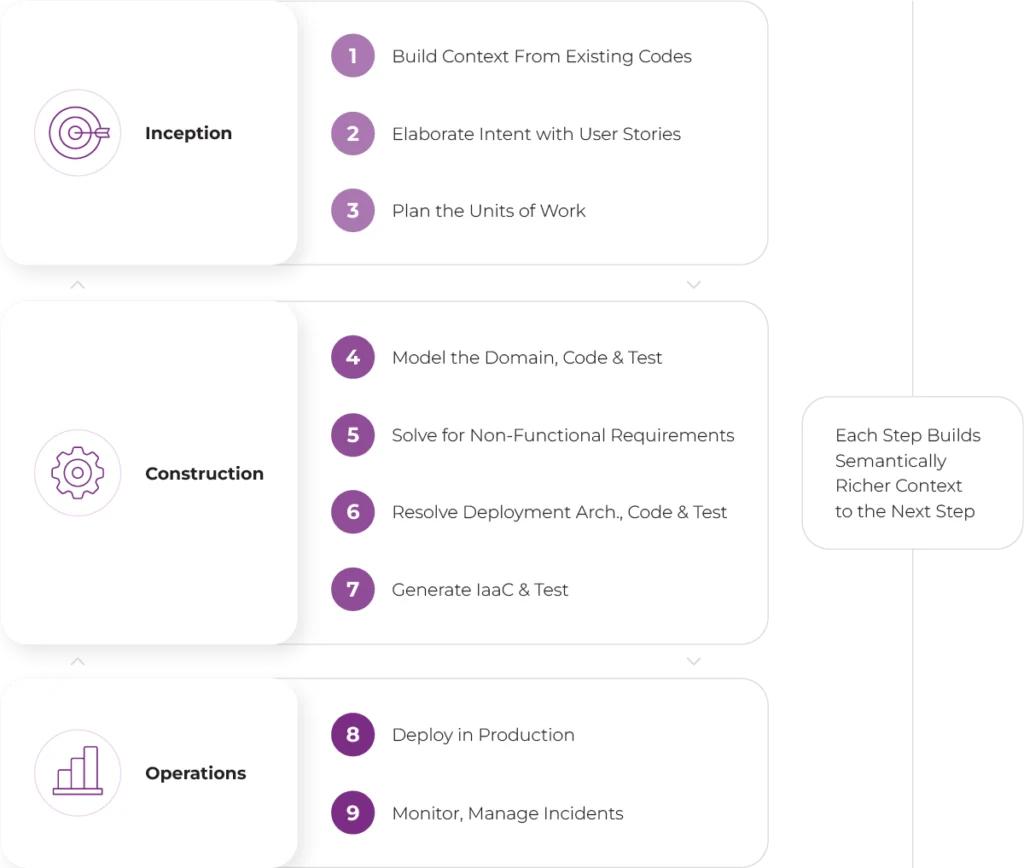
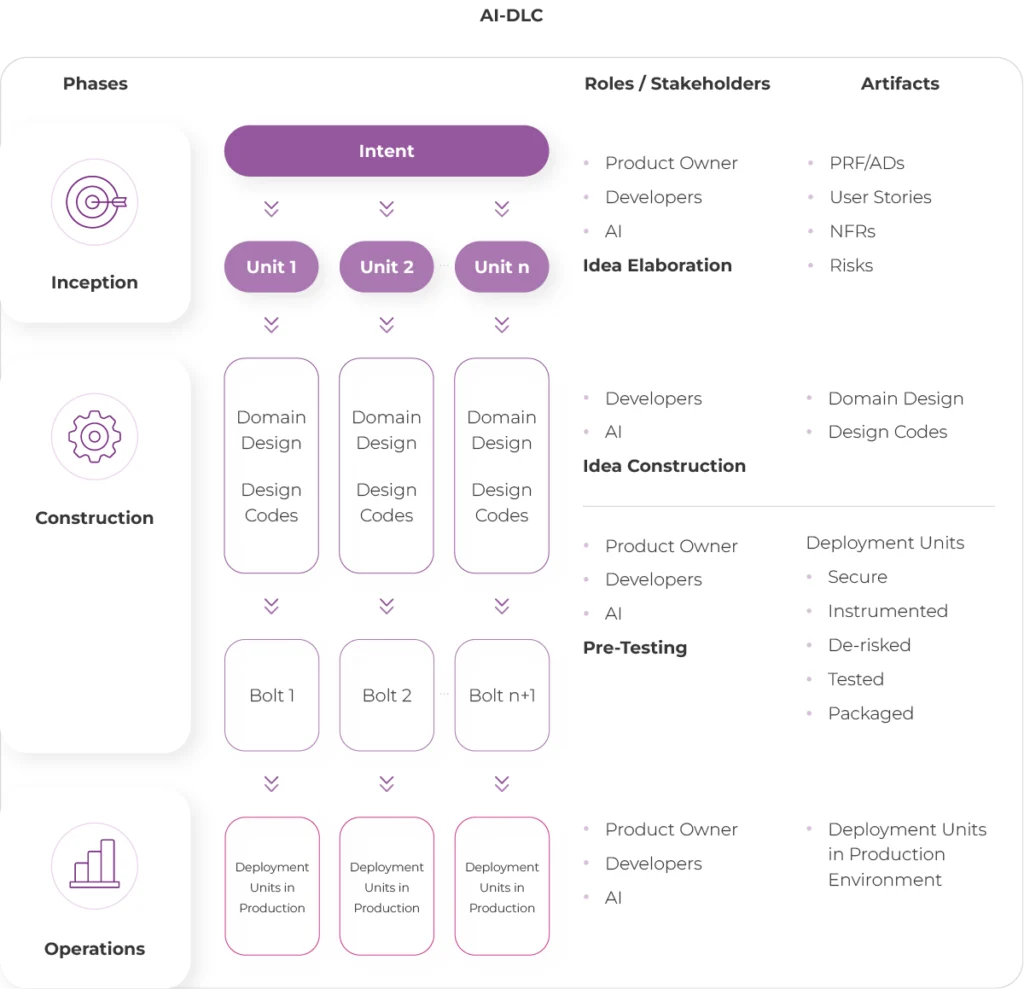
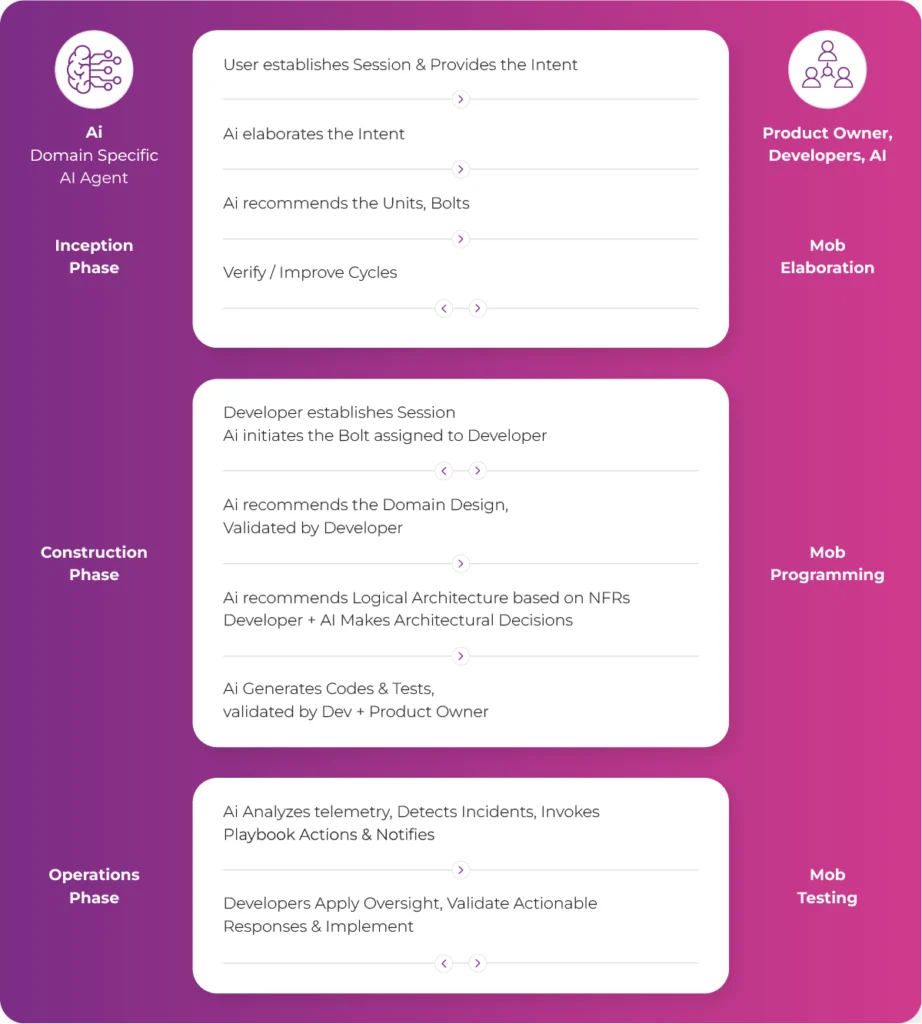
AWS describes AI-DLC as a three-phase model: Inception, Construction, and Operations. In Inception, AI transforms business intent into requirements, stories, and units of work through “Mob Elaboration”, with the whole team validating the AI’s questions and proposals. In Construction, AI uses the validated context to propose architecture, domain models, code, and tests through “Mob Construction”. In Operations, AI applies accumulated context to infrastructure, deployment, and operational tasks under team oversight. The defining idea is that every phase enriches the context for the next one, allowing AI to produce increasingly informed outputs instead of isolated answers.
This article explains how AI-DLC defines an AI-native methodology, why it matters for business and engineering leaders in software development, what artifacts and rituals it introduces, and how it can be applied both to green-field development and legacy system modernization.
Business Background and Context
The business case for AI-DLC begins with a familiar problem. Software demand grows faster than delivery capacity. Product teams want faster experimentation, operations teams want safer releases, security teams want stronger controls, and developers want fewer repetitive tasks. Traditional Agile and DevOps practices improved delivery, but they still assume that humans perform most analysis, documentation, coding, testing, and coordination manually.
AWS frames the benefits of AI-DLC around:
- Velocity – accelerating delivery from weeks to hours or days
- Innovation – enabling faster experimentation and iteration
- Quality – improving consistency and traceability
- Market responsiveness – shortening the path from idea to production
- Developer experience – reducing cognitive load and repetitive work
The business shift is therefore not merely productivity. It is operating-model change. In a conventional SDLC, requirements, design, code, tests, deployment scripts, and runbooks often live in separate tools. AI-DLC pushes these into a connected repository-based context, so the assistant does not lose reasoning history as work moves from discovery to implementation and operations.
This matters especially for regulated, distributed, or complex organizations. AI adoption without process can produce inconsistent code, hidden assumptions, and weak accountability. AI-DLC answers that concern by making AI’s role explicit and auditable. AWS’s practical workflow asks clarifying questions, creates execution plans, waits for approval, and logs decisions, inputs, and responses in an audit trail for traceability. It scales rigor to the work: simple fixes can skip unnecessary stages, while complex capabilities receive requirements analysis, architecture and testing discipline
Core Principles of AI-Driven Development Lifecycle
The first principle is methodology before tooling. AWS’s open-source AI-DLC workflow repository states that AI-DLC is fundamentally a methodology, not a single tool, and that it should work across IDEs, agents, and models rather than binding organizations to one vendor interface.
The second principle is human-in-the-loop control. AI-DLC is not a model of autonomous software delivery where AI silently changes production systems. The agent proposes, the human approves. Critical decisions require explicit confirmation, and every phase creates checkpoints where the team can review, redirect, or reject the AI’s plan. AWS’s Q Developer walkthrough emphasizes that AI-DLC asks clarifying questions, avoids assumptions, waits for approval, and records decisions for traceability.
The third principle is persistent context. Requirements, assumptions, design decisions, test plans, and generated summaries are not disposable chat transcripts. They become repository artifacts, enabling session continuity, auditability, and better future prompts.
The fourth principle is adaptive rigor. AI-DLC does not force every request through the same heavyweight ceremony. The workflow detects whether a workspace is greenfield or brownfield, analyzes codebase and complexity, and decides which stages are valuable. AWS’s repository summarizes this as adaptive intelligence, context awareness, risk-based execution, question-driven elaboration, user control, and extensibility.
AI-DLC redefines the traditional software development process by embedding AI tools across the entire software development lifecycle, not just coding tasks. Unlike a traditional software development project, this approach gives the development team shared context, traceability, and faster decision-making, which is especially valuable in complex projects.
The fifth principle is AI-native cadence. AWS replaces sprints with “bolts,” shorter work cycles measured in hours or days, and replaces epics with “Units of Work.” This language signals that AI changes planning economics: when AI drafts artifacts, plans, and tests quickly, teams can move in smaller cycles while preserving quality gates and review.
AI-DLC Framework
AI-DLC can be understood as two complementary layers. The first is the lifecycle model. Inception determines what to build and why. Construction determines how to build it, and Operations cover deployment and monitoring. AWS’s open-source workflow links these phases to requirements validation, design, unit decomposition, code generation, testing strategies, deployment automation, monitoring, and production-readiness validation.
The second is the executable workflow. In Amazon Q Developer, AI-DLC can be implemented through project rules. Markdown instructions stored in .amazonq/rules and used as context when developers chat with Amazon Q. AWS documentation describes project rules as a way to encode team coding standards and best practices so the assistant applies them consistently. The open-source repository also provides rule structures for Kiro, Amazon Q Developer, Cursor, Cline, Claude Code, GitHub Copilot, and other agents.
Together, these layers make AI-DLC concrete with reusable steering rules, stage definitions, artifact templates, and approval checkpoints placed next to the code.
Artifacts
Artifacts are the backbone of AI-DLC because they transform conversational AI into a governed engineering process. AWS’s generated documentation reference says the workflow produces artifacts under an aidlc-docs/ directory at the workspace root, and that the exact set depends on project type, complexity, and which stages run or are skipped.
At the top level, AI-DLC creates state and audit artifacts. aidlc-state.md tracks workflow state, project information, stage progress, and current status, while audit.md captures user inputs, AI responses, approvals, and timestamps. These documents matter because AI-native development must be inspectable. Leaders need to know what changed, why it was proposed, and what humans approved.
In Inception, artifacts include execution plans, requirements, clarification questions, user stories, personas, application designs, components, services, dependency maps, units of work, and story-to-unit mappings. For brownfield work, AI-DLC can also generate reverse-engineering artifacts such as architecture, API documentation, technology stack, dependencies, and code-quality assessment.
In Construction, artifacts become more implementation-oriented. AI-DLC may create functional design plans, NFR requirement plans, NFR design plans, infrastructure design plans, code-generation plans, business rules, domain entities, infrastructure design, deployment architecture, code summaries, build instructions, test instructions, and readiness summaries. AWS’s reference notes that actual application code is placed in the workspace root, while Markdown documentation lives in aidlc-docs/.
Phases and Rituals
AI-DLC changes the traditional software development process by allowing software engineers to collaborate with AI tools and ai coding agents throughout the software development lifecycle sdlc. Instead of limiting AI to code generation, the methodology integrates generative ai into requirements analysis, architecture planning, implementation, and documentation. This helps teams manage complex projects more efficiently while still maintaining human oversight for approvals, validation and technical decisions.
The phases define flow, rituals define collaboration. Inception begins with the business intent. The ritual here is Mob Elaboration. The team reviews AI-generated questions, answers them, resolves ambiguity, and validates requirements before the workflow advances. AWS’s Q Developer example shows the assistant generating clarification questions in a Markdown file, using multiple-choice options plus an open-ended “Other” option, and checking for omissions or contradictions before moving forward.
Construction uses Mob Construction. Instead of one developer disappearing to code alone, the team reviews AI-generated plans and design choices. The workflow creates a numbered code-generation plan with checkboxes, covering business logic, API layer, data layer, tests, documentation, and deployment files. Users can modify or approve that plan before code generation begins.
Operations extend the same discipline to deployment, infrastructure, monitoring, and production readiness. The current public workflow describes Operations as deployment and monitoring and lists deployment automation, infrastructure, observability setup, and production-readiness validation. In practice, the ritual should be operational review. Verify rollback strategy, observability, incident response, security posture, cost expectations, and release readiness before allowing AI-generated changes near production.
Bolts and Units of Work provide cadence and scope. A Bolt is a short, intense delivery cycle suited to AI-accelerated execution. A Unit of Work is the AI-DLC planning object that replaces broad epics with a smaller, independently executable slice of value. Together, they make delivery more granular while preserving traceability.
AI-DLC Use Case Example for Green-Field Development
Consider a company building a new customer self-service warranty portal. The portal must let customers register products, submit claims, upload proof of purchase, track claim status, and receive notifications. A traditional project might spend weeks producing separate requirements, designs, and backlog items before coding starts. AI-DLC compresses this by letting AI draft the engineering context while the team validates each decision.
Inception Phase Example
The team starts with a high-level prompt: “Using AI-DLC, build a customer warranty portal for product registration and claim tracking.” The workflow detects a greenfield workspace and creates the aidlc-docs area, state file, and audit trail. AWS’s walkthrough shows that workspace detection determines whether the project is new or existing. Greenfield projects proceed to requirements analysis, while brownfield projects first run reverse engineering.
AI then generates clarification questions, user roles, warranty validation rules, required integrations, supported document formats, authentication options, notification channels, SLA reporting, data-retention needs, and regulatory constraints. Product, engineering, security, and operations answer together during Mob Elaboration. The outcome is a requirements document, personas, user stories, acceptance criteria and a first application design.
AI-DLC then decomposes the product into Units of Work: customer identity and profile, product registration, claim submission, document upload, claim workflow, notification service, admin dashboard and audit reporting. Each unit has dependencies, acceptance criteria and potential parallelization boundaries.
Construction Phase Example
In Construction, the team selects the claim submission unit for the first bolt. AI produces a functional design, APIs, domain entities, validation rules, state machine, storage model, and error handling. It then proposes NFRs, upload limits, virus scanning, encryption, latency targets, audit logging, and availability requirements. The team reviews the plan and approves only after security and operations agree.
The code-generation plan breaks the work into steps. Create API schema, implement claim entity and repository, add upload integration, build frontend form, generate unit tests, generate integration tests, update documentation, and create deployment templates. AWS’s example shows this style of numbered plan with checkboxes as a transparency and control mechanism before code is generated.
After implementation, AI-DLC produces build and test instructions. AWS’s walkthrough states that the Build and Test stage documents dependencies, commands, test execution steps, expected results, and a build/test summary, including layers such as unit, integration, performance, security, contract, and end-to-end testing where applicable.
Operation Phase Example
For Operations, AI uses accumulated requirements, design, and infrastructure context to prepare deployment and monitoring artifacts: CI/CD steps, environment configuration, dashboards, alarms, logging standards, rollback conditions, runbooks, and cost guardrails. Human reviewers check whether controls match business risk. The same context that defined claim states and SLAs now informs alarms and runbooks. The team does not re-explain the product to a separate operations process.
AI-DLC Use Case Example for Legacy Software Modernization
Now consider a legacy monolithic claims application running on outdated infrastructure. The business wants to modernize it into cloud-native services without losing critical behavior. This is where AI-DLC’s brownfield path becomes especially useful.
Inception Phase Example
The prompt is: “Using AI-DLC, analyze and modernize this claims monolith into modular cloud services.” Workspace Detection identifies an existing codebase and routes first to Reverse Engineering. The generated documentation reference lists brownfield reverse-engineering artifacts such as business overview, architecture, code structure, API documentation, component inventory, technology stack, dependencies, and code-quality assessment.
AI reviews the repository and generates a business and technical map. Claim intake, eligibility validation, payment approval, customer notifications, reporting, batch jobs, database dependencies, external systems, and risk areas. The team validates this map because legacy systems often contain undocumented rules. Mob Elaboration focuses on deciding modernization intent. Rehost, refactor, The Strangler Fig pattern, API extraction, database decomposition, or selective rewrite.
The resulting Units of Work may include API facade, authentication modernization, claim intake extraction, notification service extraction, database schema analysis, automated regression harness, and deployment pipeline modernization.
Construction Phase Example
Construction begins with the safest unit. An API facade in front of the monolith. AI proposes interface contracts, request/response mappings, error translation, authentication integration, tests against existing behavior, and logging. The team approves a code-generation plan and requires contract tests before implementation.
For a later bolt, AI may extract notifications into a separate service. It uses reverse-engineering artifacts to identify all call sites, data dependencies, message formats, and batch interactions. It then creates a migration plan. Introducing events, dual-write or shadow mode, comparing results, switch traffic gradually, and remove old code only after evidence confirms parity. This is where AI-DLC’s audit and artifact model becomes valuable, every extracted rule, mapping decision, and test result is documented.
Operation Phase Example
Legacy modernization fails when operations are treated as an afterthought. In AI-DLC, Operations translates modernization intent into rollout controls. AI proposes deployment architecture, feature flags, dashboards comparing old and new behavior, rollback steps, error-budget policies, alert thresholds, and operational runbooks. Human teams validate business-critical metrics such as payment accuracy, claim processing latency, duplicate notification rate, and reconciliation exceptions.
AI-DLC also supports incremental modernization governance. Each Unit of Work leaves behind traceable artifacts showing what was understood, changed, tested, approved, and monitored.
AI-DLC Adoption Approach
Adopting AI-DLC should start with a controlled pilot, not a broad mandate. Choose one greenfield feature or one low-risk modernization slice where success can be measured by lead time, defect rate, test coverage, documentation completeness, developer satisfaction, and review effort. Install AI-DLC workflow rules in the chosen environment and commit them with the project so the process is reproducible.
Next, define organizational extensions. AWS’s repository describes an extension system that lets teams layer custom rules, such as security, compliance, testing, or organization-specific rules, on top of the core workflow. Extensions can include opt-in prompts and verification rules, and blocking rules can prevent a stage from proceeding until findings are resolved.
Then train teams on new roles. Product owners become intent clarifiers and value validators. Architects become reviewers of AI-proposed structures. Developers become implementation supervisors and quality engineers. Security and operations become rule authors and gatekeepers. Managers should measure outcomes rather than token usage or lines of code.
Finally, integrate AI-DLC into existing governance. Keep pull requests, CI/CD, code review, threat modeling, and production change controls. AI-DLC does not replace these. It feeds them with better context and more complete artifacts. The adoption goal is not to let AI run the lifecycle alone, but to make AI a disciplined participant in the lifecycle.
AI-Native Software Development with AI-DLC: Final Insights
AWS’s AI-DLC defines an AI-native methodology by redesigning the development lifecycle around what AI can now do well. Ask structured questions, generate plans, maintain context, draft artifacts, produce code and tests, and connect requirements to operations. Its core contribution is not code generation itself. Its contribution is a controlled operating model where AI participates throughout Inception, Construction, and Operations, while humans remain accountable for decisions.
The method’s power comes from combining speed with governance. Bolts shorten delivery cycles. Units of Work create manageable scope. Mob Elaboration and Mob Construction keep the team aligned. Persistent artifacts preserve context, audit trails support traceability, and adaptive stages prevent unnecessary ceremony. For greenfield projects, AI-DLC accelerates the journey from idea to working system. For legacy modernization, it gives teams a safer way to understand, decompose and evolve complex systems.
AI-DLC also reflects a broader shift in how software projects are delivered through the sdlc process, where each development phase becomes more responsive to customer expectations and customer feedback. By using AI to identify trends across software applications and business processes, teams can uncover insights faster and turn them into creative solutions. This supports continuous improvement, helping organizations evolve both their products and their delivery practices in a more adaptive and data-driven way.
AI-DLC will not remove the need for experienced engineers, architects, product owners, or operators. Instead, it changes where their effort goes. That is what makes AI-DLC AI-native, AI is not an add-on to the SDLC, but an integrated collaborator inside the method itself.