How Much Does Poor UX Cost Your Company? Hidden Losses in Enterprise Systems



Poor UX in corporate systems can cost companies hundreds of thousands – or even millions – each year. Yet most organisations don’t measure these losses. Instead, they are hidden in everyday inefficiencies: extra clicks, unclear workflows, errors and workarounds that scale across the organization.
In many organisations, UX in corporate systems is still treated as secondary to functionality. If a system technically works, it is considered successful. In reality, poor UX directly impacts efficiency, accuracy and operational costs. In enterprise environments, even small inefficiencies – repeated hundreds or thousands of times – quickly translate into significant financial losses.
Unlike infrastructure or licensing costs, UX-related losses are rarely visible. They are embedded in everyday activities – time spent navigating systems, correcting errors and compensating for inefficient workflows.
When aggregated across the organisation, these inefficiencies create a continuous and measurable drain on performance. Understanding the cost of poor UX requires a shift in perspective – from asking whether a system works to evaluating how efficiently it enables work.
Key Takeaways:
- Poor UX in enterprise systems directly increases operational costs
- Small inefficiencies, when repeated at scale, lead to thousands of lost hours
- UX issues generate hidden costs through errors, rework and support dependency
- Most organisations do not measure UX-related losses which makes them easy to ignore
- Improving UX can deliver measurable gains in efficiency, accuracy and overall performance
The Role of UX in Enterprise Systems and Usability Testing
In enterprise systems, UX is not about engagement it is about efficiency. Users are not exploring interfaces. They are executing repetitive tasks that directly impact business outcomes. The faster and more accurately they can perform these tasks, the more efficient the organisation becomes.
This distinction is critical because the context of use changes everything. According to Nielsen Norman Group, usability improvements in task-based environments can increase productivity by up to 83%. In enterprise systems, where tasks are repeated at scale, even small UX improvements translate into measurable operational impact.
In enterprise environments, UX becomes an operational discipline. It directly affects task completion time, error rates and the overall efficiency of business processes. Forrester research shows that organisations investing in UX can achieve returns of up to $100 for every $1 invested, largely due to improved efficiency and reduced operational waste.
Where Poor UX Creates Costs
Poor UX in enterprise systems typically creates costs in the following areas:
| UX issue | What happens | Business impact |
| Too many steps | Tasks take longer | Lost hours and lower productivity |
| Poor navigation | Users struggle to find information | Delays and frustration |
| Unclear UI / labels | Users make mistakes | Errors and rework costs |
| Inconsistent workflows | Users repeat actions or get confused | Process inefficiency |
| Lack of system feedback | Users are unsure what to do next | Increased support requests |
The cost of poor UX is not concentrated in one area. It emerges across multiple dimensions of system usage and affects both operational and strategic aspects of the organisation.
One of the most significant sources of cost is time inefficiency. Employees working with poorly designed systems often spend additional time navigating interfaces, searching for information and performing unnecessary steps. Even small inefficiencies, such as an extra click or an unclear label, can extend task completion time. When these inefficiencies occur in processes that are executed repeatedly, the impact becomes substantial. In large organisations, where hundreds or thousands of users interact with systems daily, the cumulative effect of these inefficiencies can result in thousands of lost hours each year.
Another major source of cost is error generation. Poor UX increases the likelihood of mistakes because users must interpret unclear information or navigate inconsistent workflows. These errors often propagate through the system, affecting downstream processes and requiring additional work to correct. The cost of error correction includes not only the time spent fixing mistakes but also the impact on process continuity, reporting accuracy and compliance.
Cognitive load is another important factor. Systems that require users to think excessively about how to perform tasks reduce efficiency and increase mental fatigue. Users must remember steps, interpret system behaviour and switch context between different modules. This cognitive effort slows down task execution and increases the likelihood of errors. In many cases, users develop workarounds to cope with system limitations, introducing additional inefficiencies and risks.
Training and onboarding costs also contribute to the overall impact of poor UX. When systems are difficult to use, organisations must invest in training to ensure that employees can perform their tasks. This includes the time spent learning the system, the resources required to create training materials and the reduced productivity during onboarding. Training does not eliminate UX problems; it only helps users adapt to them.
Support and maintenance overhead is another area where costs accumulate. Poor UX leads to a higher volume of support requests, as users require assistance with tasks that should be straightforward. Support teams spend time resolving usability issues rather than addressing technical problems. This increases operational costs and diverts resources from more strategic activities.
Finally, poor UX affects decision-making. Corporate systems provide access to data and support analysis. When user experience is poor, accessing and interpreting information becomes more difficult. Users may struggle to find relevant data or understand system outputs, leading to delays and uncertainty in decision-making. In environments where timely and accurate decisions are critical, this has direct business implications.
User-Centered UX & UI Design and Interaction Design Process in Corporate Systems
Corporate systems are inherently complex because they reflect business processes, regulatory requirements and technical dependencies. This complexity cannot be eliminated, but it can be managed. Without structured UX design, complexity is transferred directly to users, forcing them to navigate systems that mirror technical architecture rather than real workflows. This often leads to increased error rates, longer onboarding times and higher dependency on support functions. IBM research suggests that issues related to usability can cost up to 100 times more to fix after deployment, highlighting the importance of addressing UX early in the system lifecycle.
The role of UX design in enterprise environments is therefore not to simplify the business itself, but to ensure that system interaction does not introduce additional complexity beyond what is required by the organisation. When UX is neglected, complexity compounds over time, making systems harder to use, maintain and scale. When UX is applied effectively, systems become tools that support work rather than obstacles that hinder it, enabling employees to focus on decision-making and value creation instead of navigating inefficient processes.
UX Debt as an Organisational Risk
Similar to technical debt, organisations accumulate what can be described as UX debt. This occurs when usability issues are deferred, design inconsistencies are tolerated and user needs are not systematically addressed during system development.
UX debt manifests as fragmented interfaces, inconsistent interaction patterns and inefficient workflows. Over time, these issues compound, making systems increasingly difficult to use and more expensive to maintain.
The key characteristic of UX debt is that it grows silently. Unlike system failures, it does not trigger immediate alarms. Instead, it gradually reduces efficiency and increases operational friction. Organisations may compensate through training, support or additional processes, but these are temporary solutions that do not address the underlying problem.
As UX debt increases, the cost of change also rises. Redesigning a system with deeply embedded usability issues becomes complex and resource-intensive. This often leads organisations to postpone improvements, further exacerbating the problem.
Managing UX debt requires a proactive approach. Regular usability evaluations, continuous design improvements and integration of UX practices into development processes help prevent accumulation and reduce long-term costs.
The Hidden Cost of Workarounds and Shadow Processes
One of the clearest signs of poor UX in corporate systems is the emergence of workarounds. When systems fail to support users effectively, employees don’t stop working – they adapt. They create their own solutions outside the system. These workarounds often take the form of spreadsheets, manual tracking or undocumented processes outside official workflows. In practice, workarounds are a clear signal that the system is failing its users.
While workarounds may appear as a practical short-term solution, they introduce significant long-term risks. They fragment data, reduce transparency and create inconsistencies across the organisation. Information stored outside the system of record becomes difficult to track, validate and audit. This is particularly critical in industries where compliance and data integrity are essential.
Moreover, shadow processes increase operational complexity. Instead of a single, well-defined workflow, organisations end up managing multiple parallel processes. This leads to duplication of effort, increased likelihood of errors and difficulties in scaling operations. What initially appears as user adaptability becomes, over time, a structural inefficiency embedded in the organisation.
From a cost perspective, workarounds represent hidden operational overhead. They consume time, require maintenance and often rely on individual knowledge rather than institutional processes. When employees leave, this knowledge is lost, further increasing organisational risk.
Addressing UX issues at their source eliminates the need for workarounds, restoring process integrity and reducing hidden inefficiencies.
Why Poor UX in Corporate Systems Remains Undetected
One of the main reasons why organisations underestimate UX is that its costs are distributed and indirect. Poor UX does not typically result in a single visible failure. Instead, it creates a series of small inefficiencies that accumulate over time. These inefficiencies are often perceived as part of normal operations rather than as symptoms of design issues.
Another factor is the lack of direct ownership. UX in corporate systems often falls between business teams, IT departments and operations. Business defines requirements, IT delivers functionality and operations use the system daily. However, the experience of users is not always systematically analysed or optimised. This leads to a situation where systems meet technical requirements but fail to support users effectively.
Additionally, many organisations rely on training to compensate for poor UX. Instead of improving system design, they invest in onboarding and documentation. While this approach may enable users to perform tasks, it introduces additional costs and does not address the root cause of inefficiencies.
Finally, legacy systems play a significant role. Many corporate systems have evolved incrementally, with new features added over time without a comprehensive redesign. This results in fragmented workflows, inconsistent interfaces and duplicated functionality. Over time, these issues compound, making systems increasingly difficult to use.
How to Measure the Cost of Poor UX
To understand the real impact of UX in corporate systems, organisations must combine measurement with an understanding of scale. UX inefficiencies do not exist in isolation. Their true cost emerges when they are repeated across users, processes and time. This is what defines the multiplier effect of enterprise UX.
The starting point is measurement. Organisations need to identify key workflows and track operational metrics such as task completion time, error rates, rework and support dependency. These metrics already exist in most systems – in logs, process data or support records – but are rarely analysed through the lens of user experience.
Individually, these inefficiencies may appear negligible. A few extra seconds to complete a task, a slightly higher error rate or an additional support request do not immediately signal a problem. However, in enterprise environments, where systems are used at scale, these small inefficiencies accumulate rapidly.
This is where the multiplier effect becomes critical.
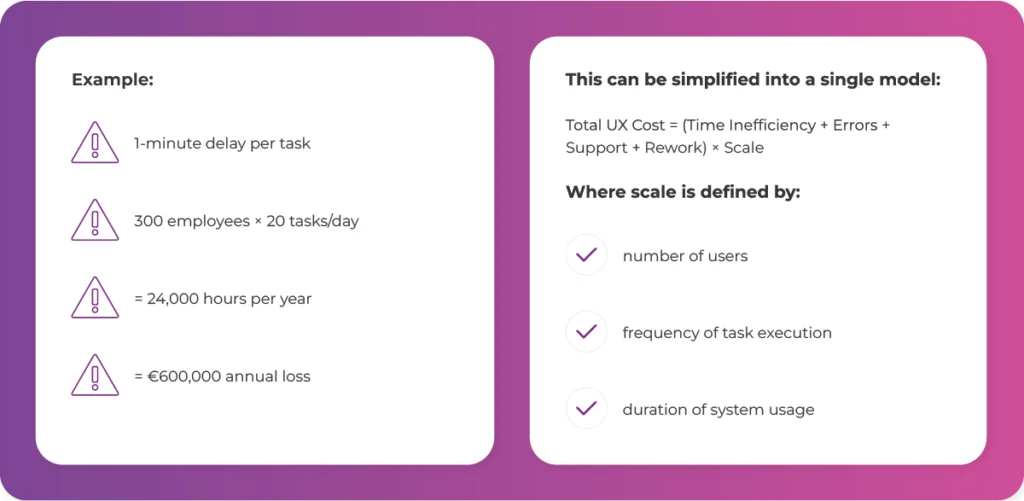
Consider task completion time. A delay of one minute in a single workflow may seem insignificant. However, if this task is performed by 300 employees, 20 times per day, the organisation loses 6,000 minutes daily. This translates into approximately 100 hours per day, 2,000 hours per month and over 24,000 hours annually.
When translated into cost, the impact becomes explicit. Assuming an average cost of €25 per hour, this inefficiency alone results in €600,000 per year. In many cases, the actual cost is higher, particularly when factoring in overhead, management time or opportunity cost.
Even small inefficiencies can scale into significant financial losses:
Time inefficiency is only one dimension. Error rates introduce an additional layer of cost. In poorly designed systems, users are more likely to input incorrect data, misinterpret system feedback or follow inconsistent workflows. These errors require detection, correction and validation, often involving multiple roles and additional process steps.
For example, if even 5% of transactions require correction, and each correction takes 10 minutes, the impact quickly scales in high-volume environments. Across thousands of daily operations, this translates into hundreds of hours of additional work each week.
Rework further amplifies this effect. When users must repeat tasks due to unclear workflows or system limitations, the same effort is effectively paid for multiple times. High rework rates are a strong indicator of UX friction and directly increase operational cost without creating additional value.
Support dependency provides another measurable signal. In systems with poor UX, support teams often handle requests that are not technical failures but usability issues – unclear navigation, confusing labels or non-intuitive workflows. Each support interaction consumes time on both the user and support side, creating a compounded cost.
For instance:
- 1,000 UX-related tickets per month
- average handling time: 15 minutes
- combined cost per hour (user + support): €40
This results in €10,000 per month, or €120,000 annually, spent on issues that could often be eliminated through better design.
When these dimensions are combined – time inefficiency, errors, rework and support – the multiplier effect becomes evident. Costs do not grow linearly; they scale with organisational size and process frequency.
Importantly, this effect also works in reverse.
Improvements in UX produce multiplied gains. Reducing task time by 10–20%, decreasing error rates or simplifying workflows leads to exponential benefits when applied across the organisation. A seemingly modest optimisation at the interaction level can translate into thousands of hours saved and significant cost reductions annually.
To capture this impact, organisations must establish a baseline before implementing UX improvements. This includes measuring current task times, error rates and support volumes. After changes are introduced, the same metrics should be tracked under comparable conditions.
The difference between baseline and post-improvement performance represents the measurable value of UX.
For example:
- 15% reduction in task time in a high-frequency workflow
- 30% reduction in error rate
- 20% decrease in support requests
Individually, these improvements may appear incremental. However, when applied at scale, they translate into substantial operational gains – reduced workload, lower costs and increased process efficiency.
This is the fundamental reason why enterprise UX should be treated as an operational and strategic discipline. It is not about optimising isolated interactions but about improving system performance across the organisation.
Without measurement, the multiplier effect of poor UX remains hidden. With measurement, it becomes quantifiable – and actionable.
Ultimately, organisations that understand and manage this relationship gain a significant advantage. They are able to identify where inefficiencies scale, prioritise high-impact improvements and systematically convert UX into measurable business value.
The Impact of Poor UX on Employee Experience and Retention
While operational costs are often the primary focus, poor UX also has a direct impact on employee experience. Corporate systems are tools that employees interact with daily. When these tools are inefficient, frustrating or difficult to use, they contribute to overall job dissatisfaction.
Employees expect internal systems to support their work, not hinder it. When systems require excessive effort to complete simple tasks, users experience frustration, reduced motivation and cognitive fatigue. Over time, this affects engagement and productivity.
In competitive labour markets, employee experience becomes a strategic factor. Organisations invest heavily in attracting and retaining talent, yet internal systems often remain overlooked as a component of that experience. Poor UX can indirectly contribute to higher turnover, particularly in roles that rely heavily on system interaction.
Additionally, inefficient systems limit employee potential. Skilled professionals spend time navigating interfaces instead of focusing on decision-making and value creation. This represents not only a cost but also a missed opportunity to leverage human capital effectively.
Improving UX in corporate systems is therefore not only an operational decision but also an investment in employee experience and organisational culture.
Practical example: Financial System Optimisation
A financial organisation relied on an internal system used by over 500 employees to process transactions and generate reports. Over time, the system had become increasingly complex, with multiple modules and inconsistent interaction patterns.
Users reported that processes were slow and error-prone. A UX audit and usability testing revealed that workflows required unnecessary steps, data had to be entered multiple times and system feedback was inconsistent. These issues resulted in increased task completion time and frequent errors.
Instead of redesigning the entire system, the organisation focused on targeted UX improvements. Workflows were simplified, redundant steps were removed and interaction patterns were standardised. UI UX designers collaborated with business and technical teams to ensure that the system aligned with real user workflows.
After implementing these changes, task completion time decreased by 28 percent, error rates dropped by 35 percent and support requests were reduced significantly. The organisation also observed a reduction in onboarding time for new employees.
This case demonstrates that improving user experience can lead to measurable operational and financial benefits without requiring large-scale system replacement.
| Before UX improvements: | After UX improvements: |
| – complex workflows | – task completion time ↓ 28% |
| – repeated data entry | – error rates ↓ 35% |
| – inconsistent system feedback | – significant reduction in support requests |
| – faster onboarding for new employees |
Practical example: Logistics and Operations Efficiency
A logistics company used an internal system to manage shipments across multiple regions. The system had evolved over time, resulting in different workflows for similar processes. Users experienced delays, confusion and frequent errors.
Through usability testing and UX analysis, the organisation identified key friction points in navigation and workflow structure. Improvements focused on aligning the system with actual operational processes, simplifying navigation and improving feedback.
As a result, processing time decreased by 25 percent, error-related delays were significantly reduced and overall efficiency improved. The system became more predictable and easier to use, improving both user experience and business performance.
| Before UX improvements: | After UX improvements: |
| – inconsistent workflows across regions | – processing time ↓ 25% |
| – navigation issues | – significant reduction in error-related delays |
| – frequent user errors | – improved operational efficiency |
| – more predictable and user-friendly system |
UX as a Strategic Investment for Customer Satisfaction
In corporate systems, UX should be treated as a strategic capability rather than an optional layer. Good UX design reduces inefficiencies, improves productivity and supports scalability. It enables organisations to operate more effectively and adapt to changing requirements.
UI UX designers play a key role in this process, bridging the gap between business needs and technical implementation. Through user research, usability testing and design, they help organisations create systems that support users rather than hinder them.
By investing in UX, organisations can reduce operational costs, improve employee satisfaction and achieve better business outcomes.
Conclusion: UX, Customer Experience and Competitive Edge
The cost of poor UX in corporate systems is real and measurable. It affects time, productivity, error rates and decision-making. While these costs may not always be visible, they accumulate continuously and impact organisational performance. By recognising UX as a key factor in efficiency, organisations can begin to address these challenges. Through UX design, usability testing and structured UX services, it is possible to reduce inefficiencies and improve system performance. In enterprise environments, user experience is not about aesthetics. It is about enabling people to work effectively. And in doing so, it determines how much a company gains – or loses each year.
UX designers and interaction designers work within a structured design process that includes prototyping tools, design ideas, and iterative improvements based on observing users. This approach ensures that real users interact effectively with systems, whether in mobile apps, web systems, or other digital products.
When systems are designed with accessibility in mind, following web content accessibility guidelines, they better support human system interaction and account for human factors, making digital experiences more inclusive. This not only improves usability across digital products and mobile apps, but also strengthens brand loyalty, enhances business objectives, and creates a clear key differentiator in competitive markets.
By applying user-centered design principles, focusing on information architecture, visual design, and usability, and supporting decisions with data analysis and key metrics (for example from Google Analytics), organisations can create systems that align with business objectives. This not only improves efficiency and user satisfaction but also strengthens brand loyalty, accessibility and overall competitive edge.