Legacy Software Modernization Services Explained: Benefits, Challenges and GenAI Use Cases

In today’s rapidly evolving digital landscape, legacy software modernization services have become essential for businesses aiming to maintain a competitive edge. As technology advances, many organizations find themselves tied to outdated systems that no longer meet modern expectations. The question is no longer whether companies should modernize, but what exactly modernization is, why it matters, and how to approach it effectively.
What are legacy software modernization services?
Legacy Software Modernization Services are a set of processes, tools, and strategies used to update, transform, or replace outdated software systems to improve performance, security, scalability, and business agility.
This definition reflects a broader shift in how organizations treat legacy systems – not as liabilities to be replaced overnight, but as assets that can be transformed into modern, scalable platforms.
Why legacy software modernization matters more than ever? Business objectives
Why should companies invest in legacy system modernization?
Because legacy systems increasingly limit growth, increase costs, and expose organizations to operational and security risks.
Legacy systems also struggle with integration. In a world driven by APIs, cloud platforms, and real-time data, outdated architectures become a bottleneck. This directly affects customer experience, time-to-market, and overall competitiveness.
Many organizations still rely on systems built decades ago. According to Gartner, up to 70–80% of IT budgets are spent on maintaining legacy environments, leaving minimal room for innovation. At the same time, a report by McKinsey & Company estimates that companies with high technical debt can lose up to 20–40% of their technology capacity.
That is why companies are increasingly investing in legacy application modernization services and partnering with a specialized legacy software modernization company to realign their technology with business goals. Market research forecasts that the legacy software modernization services market will grow at ~16.2% CAGR, expanding from $13.02B in 2024 to $15.14B in 2025 – a clear sign of rising investment and demand.
Traditional vs GenAI modernization
| Area | Traditional Approach | GenAI-driven Approach |
| Code analysis | Manual | Automated (AI-assisted) |
| Refactoring | Time-consuming | Automated / semi-automated |
| Documentation | Often missing/manual | AI-generated instantly |
| Testing | Manual test creation | AI-generated test cases |
| Speed | Slow | 40–50% faster |
| Cost | High | Reduced significantly |
How legacy software modernization services work in practice
How does legacy software modernization actually work?
It starts with system assessment, followed by selecting the right transformation strategy and executing it in a controlled, incremental way.
Modernization is not a one-size-fits-all process. Some systems require only infrastructure changes, while others demand deep architectural transformation. The most common approaches include rehosting, refactoring, replatforming, and full system replacement – each with different trade-offs in cost, risk, and long-term value.
What matters most is alignment with business priorities. A well-defined roadmap ensures that modernization delivers measurable outcomes without disrupting critical operations.
Importantly, legacy system modernization is not about discarding existing systems entirely. Many legacy applications contain valuable business logic built over years. The goal is to preserve that value while making it usable within modern architectures.
The real benefits behind legacy application modernization services
The impact of legacy software modernization services goes far beyond technical upgrades. A 2025 survey of more than 500 IT professionals found that 62% of organizations still rely on legacy software systems, with 43% citing security vulnerabilities as a major modernization driver. This underscores why legacy system modernization services are essential for both operational resilience and risk mitigation.
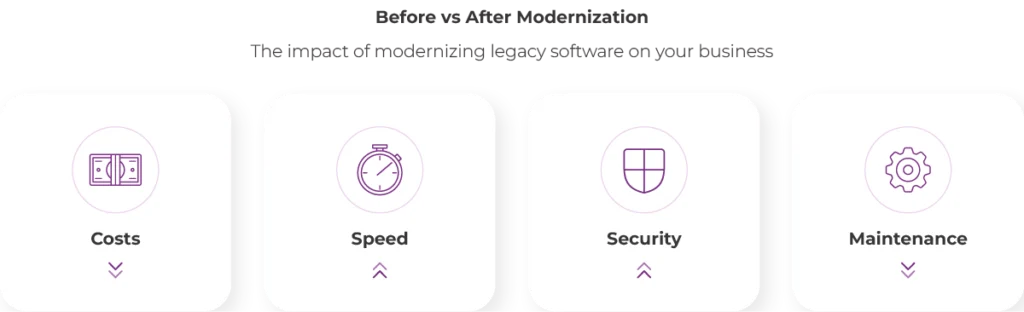
Organizations that modernize effectively often report measurable improvements. Studies show that modernization initiatives can reduce infrastructure and maintenance costs by 20–40%, while also accelerating release cycles and improving system reliability.
Security is another major driver. Modern systems are better equipped to meet compliance requirements such as GDPR and reduce exposure to vulnerabilities commonly found in outdated technologies.
Equally important is agility. With modern architectures, companies can introduce new features faster, integrate with external platforms more easily, and respond to market changes with significantly less friction.
According to IDC, organizations that invest in modernization initiatives can achieve up to 30% faster time-to-market and significantly improve operational efficiency.
In practice, modernization shifts IT from a cost center to a growth enabler.
Challenges in legacy system modernization
Modernization, however, is not without risk.
One of the most complex aspects is data migration. Moving large volumes of data between systems introduces potential inconsistencies and requires careful validation. Even small errors can have significant business impact.
Another common issue is hidden functionality. Legacy systems often evolve over time without proper documentation, making it difficult to identify all dependencies. Without involving stakeholders and domain experts, critical features can be lost during transformation.
Security also becomes a concern during the transition phase. While modernization ultimately improves security, poorly managed migrations can temporarily expose vulnerabilities.
These challenges highlight the importance of working with an experienced legacy software modernization company, capable of managing both technical complexity and business risk. Recent ROI studies show that effective legacy modernization efforts can yield up to 74% reduction in IT costs, 30% operational efficiency gains, and 43% faster time-to-market, demonstrating tangible business value beyond theory.
| Benefits | Risks |
| Lower operational costs | Data migration issues |
| Better security | Temporary vulnerabilities |
| Faster time-to-market | Hidden dependencies |
| Higher scalability | Complexity of transformation |
Real-world use cases of legacy software modernization services
The value of modernization becomes clearer when looking at real-world scenarios.
In the financial sector, organizations have migrated core banking systems to cloud-based infrastructure, reducing operational costs by around 30% while enabling real-time transaction processing. This shift also allowed faster rollout of digital services.
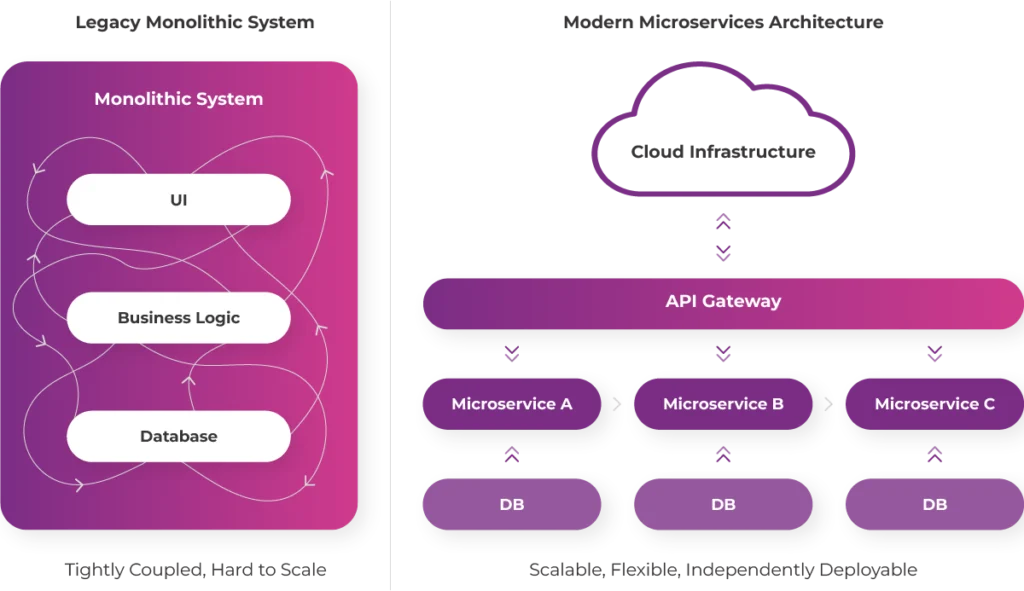
Retail companies have taken a different approach, breaking down monolithic e-commerce platforms into microservices. As a result, they reduced deployment cycles from months to weeks and significantly improved scalability during peak traffic periods.
In healthcare, modernization initiatives have focused on security and interoperability. By updating legacy systems, providers improved compliance with data protection regulations and enabled integration with modern patient management platforms.
These examples show that legacy application modernization services deliver tangible business outcomes across industries.
The role of GenAI in legacy software modernization process
How is GenAI changing legacy software modernization?
It is accelerating analysis, refactoring, documentation, and testing – significantly reducing time and cost.
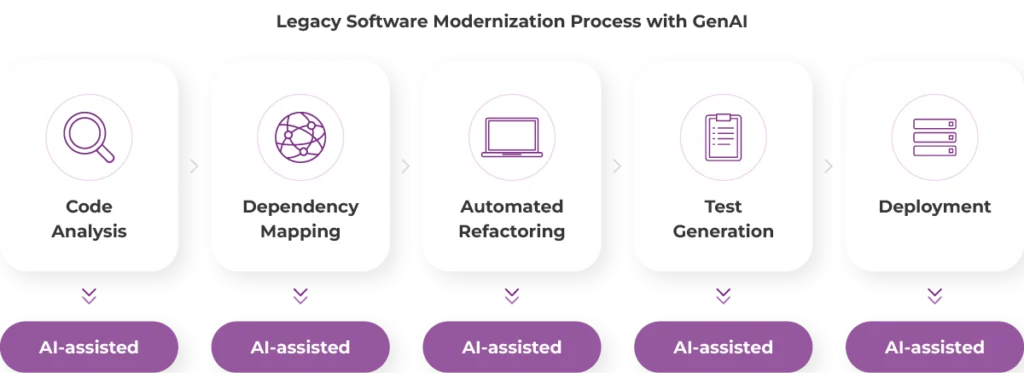
GenAI is transforming how organizations approach modernization. Instead of relying solely on manual processes, teams can now use AI to analyze legacy codebases, identify dependencies, and detect potential risks in a fraction of the time.
One of the most impactful use cases is automated refactoring. GenAI tools can convert legacy code into modern languages or optimize existing code for better performance and maintainability.
Documentation is another critical area. Many legacy systems lack up-to-date documentation, which slows down modernization efforts. GenAI can generate clear, structured documentation, improving knowledge transfer and reducing onboarding time.
According to McKinsey & Company, GenAI can accelerate modernization timelines by 40–50% and reduce costs significantly, making previously unviable projects feasible. Test generation also becomes more efficient. AI can automatically create test cases, increase coverage, and identify issues earlier in the development cycle.
Compared to traditional modernization approaches, GenAI-driven modernization significantly reduces manual effort, improves accuracy, and enables faster decision-making across the software development lifecycle. As a result, GenAI is not just an enhancement – it is becoming a core component of modern legacy software modernization services.
How to choose a legacy software modernization company
What does a legacy software modernization company actually do?
A legacy software modernization company helps organizations assess, transform, and migrate legacy systems using proven methodologies, modern architectures, and automation tools.
Choosing the right partner is critical because modernization affects core business systems.
The most important factors include technical expertise in both legacy and modern technologies, a structured approach to risk management, and experience in delivering complex transformation projects. Increasingly, the ability to leverage AI and automation is also becoming a differentiator.
Equally important is alignment with business goals. The right partner should not only execute the modernization process, but also help define the strategy and prioritize initiatives based on business impact.
Top trends in Legacy Software Modernization Services 2026
The landscape of legacy software modernization services continues to evolve, driven by new technologies and changing business needs.
One of the most important trends is AI-assisted modernization, where intelligent tools support decision-making, code analysis, and migration processes. Closely related is the rise of GenAI-driven refactoring, which significantly reduces manual effort.
Cloud-native architectures are becoming the default target state, enabling scalability, resilience, and faster innovation. At the same time, organizations are moving toward composable systems, replacing monolithic applications with modular, flexible components.
Another emerging trend is platform engineering, which focuses on building internal developer platforms that standardize processes and improve productivity across teams.
Together, these trends show that modernization is shifting from a one-time initiative to a continuous capability embedded in the organization.
Legacy Modernization Services results in Enhanced Security and Lower Operational Costs
Legacy systems remain a critical part of many organizations, but the way they are managed is changing fundamentally. To effectively modernize legacy systems, companies must adopt a clear modernization strategy and treat legacy system modernization services as a continuous, structured process rather than a one-time modernization project.
Modernization of legacy software systems and legacy apps is essential for maintaining business continuity while addressing growing security vulnerabilities and evolving business requirements. Through a thorough assessment of existing systems, organizations can identify constraints, optimize business processes, and align technology with core business operations.
By investing in legacy software modernization services, companies can reduce costs, improve security, and unlock new opportunities for innovation and business growth. These efforts often involve transitioning older systems to modern platforms, integrating new digital technologies, and supporting software development that is more agile and scalable. As a result, organizations achieve improved performance, stronger technology integration, and greater business value.
When combined with cloud technologies and GenAI, modernization becomes a powerful driver of digital transformation, enabling better alignment with business processes and long-term objectives. In this context, modernization is not just a technical upgrade but a strategic initiative that directly supports business growth and reduces cost savings while overcoming existing business constraints.
The key challenge is no longer understanding the need for modernization, but executing it in a way that delivers real, measurable value across business operations and ensures long-term scalability.
FAQ: Common questions about legacy modernization
What is the fastest way to modernize legacy software?
The fastest approach is typically rehosting or replatforming, especially when combined with GenAI tools that automate code analysis and migration.
How much does legacy system modernization cost?
Costs vary widely depending on system complexity, but organizations typically reduce long-term IT costs by 20–40% after modernization.
Can GenAI replace legacy systems automatically?
Not entirely. GenAI can accelerate analysis, refactoring, and testing, but human oversight is still required for architecture decisions.
What are the risks of legacy modernization?
The biggest risks include data migration errors, undocumented features, and temporary security vulnerabilities during transition.