Physical AI: More Than Chatbots

For years, industrial digitalization was largely focused on collecting data from machines, visualizing KPIs and optimizing processes through dashboards, MES systems or analytics platforms. Then came the wave of generative AI and industrial copilots. Suddenly, every industrial software vendor started talking about chat interfaces, document search and AI assistants.
Useful? Yes. Sufficient? Absolutely not.
Factories Are Not Document Systems
Factories are not document systems. They are dynamic physical environments full of movement, geometry, constraints, deviations and operational context. Machines move. Conveyors drift over time. Layouts evolve. Tooling changes. Engineering assumptions diverge from operational reality. Operators work in confined spaces where the difference between CAD and reality is measured in millimeters.
This is where the next phase of industrial AI starts – not with better prompts, but with spatial and operational understanding.
At TT PSC we increasingly see industrial companies shifting their attention from “AI on top of data” toward systems capable of understanding and interacting with the physical world itself. The discussions are no longer only about predictive maintenance or chatbot interfaces. They are about:
- reconstructing large industrial environments from reality capture data,
- validating manufacturing layouts before physical changes are made,
- enabling collaborative engineering reviews inside spatial environments,
- supporting distributed operations through lightweight wearable devices,
- and creating continuously evolving operational digital representations of factories.
Why Physical AI Needs Cloud and Edge HPC
This transition changes the required architecture completely. Physical AI in industrial environments cannot rely exclusively on local compute. Reality capture, SLAM, neural reconstruction, simulation and spatial reasoning are computationally intensive workloads. Yet the industrial world does not want heavy, power-hungry devices. Operators expect lightweight wearables, long battery life, safety and ergonomics.
This creates a very important architectural shift: industrial perception and spatial intelligence increasingly need to operate across cloud and edge HPC infrastructures.
At TT PSC, this direction became one of the foundations of our long-term spatial computing strategy. In May 2026, the United States Patent and Trademark Office granted TT PSC patent US 12,632,506 B2 covering architectures for offloaded SLAM processing in distributed spatial computing environments.
The significance of this approach extends far beyond AR overlays. What matters is enabling lightweight industrial devices to participate in computationally intensive spatial workflows without carrying the full burden of perception, mapping and reconstruction locally. In practice, this means industrial systems capable of combining:
- wearable devices,
- cloud HPC,
- distributed perception,
- operational context,
- and collaborative spatial workflows.
From Scanning to Operationalising Reality Capture
We already see where the industry is heading – large manufacturing organizations increasingly explore how to:
- reconstruct brownfield factories into usable operational environments,
- analyze conveyor clearances and spatial feasibility before launch,
- create reusable engineering representations from point clouds,
- support collaborative design reviews inside photorealistic industrial spaces,
- enable remote operational assistance through spatially-aware systems,
- and building platforms for robotics training that starts with human augmentation
Importantly, most of these organizations already possess massive amounts of spatial data:
- LiDAR scans,
- point clouds,
- panoramic imagery,
- CAD layouts,
- operational documentation.
The problem is no longer “how to scan”. The problem is how to operationalize reality capture at industrial scale. This is one of the reasons why TT PSC has been investing heavily in spatial computing and industrial XR for years, long before “Physical AI” became a fashionable term.
Physical AI Proven in European Projects
Within the European Horizon project PeneloPe, TT PSC worked on sustainable digital prefabrication workflows for shipbuilding, using bidirectional CAD-AR integration and reality capture to support fitting-pipe fabrication in highly dynamic shipyard environments. The challenge was very practical: large cruise ships contain thousands of customized fitting pipes which traditionally require manual measurements, physical mockups and repeated fabrication iterations.
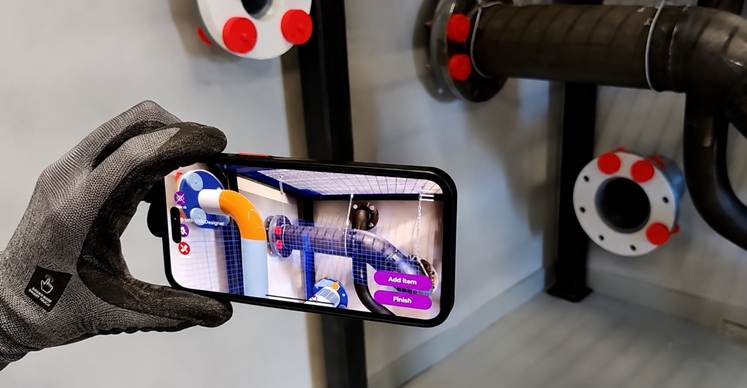
TT PSC developed workflows where on-site engineers captured the real spatial context directly in the shipyard, exported the geometry into CAD environments, and immediately validated new pipe routings back in AR in situ. This reduced dependence on physical mockups and enabled collaborative closed-loop engineering workflows between field operations and CAD teams.
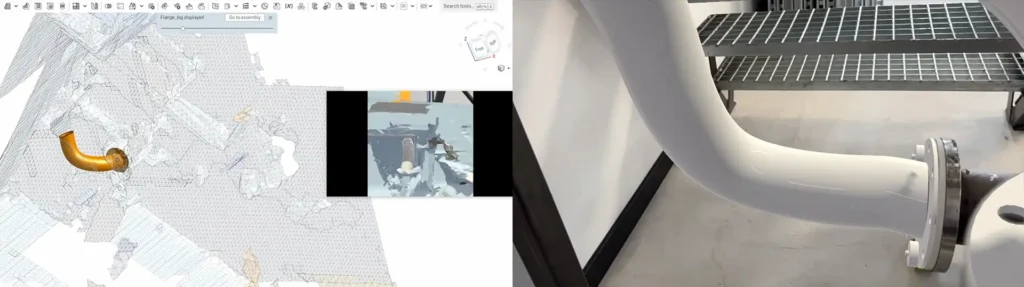
That project addressed problems which are now becoming central for industrial Physical AI:
- continuous alignment between engineering assumptions and operational reality,
- spatial validation in brownfield environments,
- collaborative engineering workflows,
- and distributed perception pipelines.
Similar directions are emerging in other European initiatives. In Mari4_YARD, aimed at upskilling and reskilling European shipyards,TT PSC worked on digital shipbuilding workflows integrating spatial context and industrial operations for shipyard modernization. In Fluently, the focus shifted toward collaborative human-robot workflows and AI-supported disassembly processes for battery recycling environments. GreenShift expands this even further into AI and HPC for sustainable transport innovation, recognizing that future industrial systems will increasingly require scalable compute infrastructure capable of supporting advanced simulation, reconstruction and AI workloads. Our role in this project includes not only bringing advanced expertise in data processing, AI-driven analytics or creating educational content with industrial perspective but also serving TT PSC SkillWorx as a reference platform leveraging reality capture, spatial intelligence, visual inspections large language models and high-performance computing.
From Data-Centric to Environment-Centric Industrial AI
The convergence is becoming clear. Industrial AI is evolving from data-centric systems, toward environment-centric systems. The next decade of industrial competitiveness will not depend only on who has the best chatbot interface. It will depend on who can combine into scalable operational platforms:
- LLMs, VLMs, VLAs
- spatial intelligence,
- operational workflows,
- cloud HPC,
- simulation,
- and industrial integration
Factories are physical systems.
Future industrial AI must understand them as such.