PPWR Is Not Just About New Packaging Requirements. It Is a Test of Product Data Management

On 12 August 2026, the Packaging and Packaging Waste Regulation (PPWR) will start to apply. For manufacturers, this means new obligations related to packaging, but also something much broader: the need to effectively manage data, documentation, product versions and changes throughout the entire product lifecycle.
And this is exactly where regulation meets PLM.
A great deal has already been written about PPWR – the Packaging and Packaging Waste Regulation. Companies know that the new rules cover areas such as packaging design and composition, recyclability, recycled content, packaging minimisation and required documentation.
So I do not want to summarise the regulation yet again.
From the perspective of a PLM solution architect, a different question is much more interesting:
What happens next, when regulatory requirements have to be translated into the day-to-day operations of an enterprise?
How quickly can you identify which products use a specific packaging material? What happens when its supplier changes the specification? How do you determine which products are affected by that change? Where is the current documentation stored? Who approved it? And several years from now, will you still be able to show which data was used to approve a particular packaging variant?
This is no longer solely a regulatory issue.
It is a product information management issue.
12 August Is the Beginning, Not the End, of the Preparation Process
PPWR, Regulation (EU) 2025/40, entered into force on 11 February 2025 and will start to apply from 12 August 2026. Further requirements will be introduced progressively over the following years. From a PLM perspective, however, what matters is not only what the regulation requires, but how an enterprise will be able to demonstrate and maintain compliance.
PPWR requires manufacturers, among other things, to carry out conformity assessments and prepare technical documentation. The technical documentation and EU declaration of conformity must be retained for five years for single-use packaging and ten years for reusable packaging. The regulation also requires changes in packaging design and characteristics to be taken into account and, where those changes may affect conformity, for conformity to be reassessed.
There is another interesting element. Upon a reasoned request from a competent authority, a manufacturer should provide the information and documentation necessary to demonstrate conformity, with the relevant documentation made available within ten days of receiving such a request.
And this raises a very practical question:
Does the enterprise actually have this information under control?
Where Does Packaging Information Actually Live?
In an ideal world, the answer would be simple.
We have a product, its structure, the packaging assigned to it, its components, materials, properties, suppliers, documentation and a complete history of changes.
In reality, the data may be spread across ERP, PDM or PLM systems, CAD documentation, QMS, PIM, SharePoint, Excel files, documents received from suppliers and email correspondence. Each of these systems may play an important role. The problem begins when it is unclear which system is the source of a particular piece of information, how the data is connected, and whether a change made in one place will be properly reflected elsewhere. PPWR can expose the consequences of this fragmentation very clearly.
Imagine an enterprise offering several thousand products. Some simple questions come up:
Which of them use packaging containing material X supplied by company Y?
How long does it take to answer?
More importantly, will the answer be complete?
PLM Allows You to Treat Packaging as Part of the Product
For many years, PLM systems were associated primarily with engineering documentation and CAD. Today, their role is much broader. PLM can provide the backbone of the product digital thread, connecting information created at different stages of the product lifecycle. In the context of PPWR, this means being able to look at packaging not as a PDF document or a purchasing item, but as an element linked to a specific product and its configuration.
We can therefore build relationships such as:

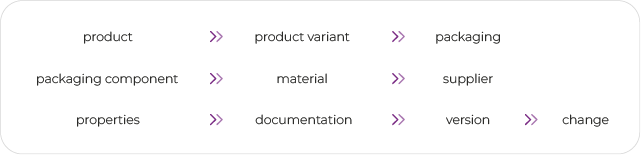
PTC Windchill supports, among other capabilities, product structure and BOM management, configuration and change management, as well as collaboration between internal teams and suppliers around product data.
The value, however, does not come simply from having a structure in a system. The value comes from being able to answer specific business questions.
- What packaging do we use for a particular product?
- What exactly is it made of?
- Which version is currently valid?
- Which products are affected by a particular material?
- What documents are associated with it?
- What has changed since the previous version?
This is the fundamental difference between storing data and actually managing it.
A Supplier Changes a Material. What Happens Next?
This is one of the examples that best illustrates why I also see PPWR as a PLM topic.
Suppose a supplier informs a manufacturer about a change in the parameters of a material used in packaging. Receiving that information is only the beginning. The company needs to determine which packaging components use the material, which products use those packaging components, whether the change affects their properties, which documentation needs to be updated, and who should review and approve the change.
If a company has a dozen products, it may be possible to carry out this analysis manually. If it has several thousand products, multiple variants, suppliers and markets, the issue quickly stops being a problem for an individual employee. It becomes a systemic problem.
And this is where change management comes in.
A change can be managed through a controlled workflow. We know what it concerns, which objects are linked to it, who assessed it, what decisions were made, and which version of the product or packaging resulted from the change. A PLM system does not decide for the company whether a particular packaging solution complies with PPWR. What it can do is ensure that the information required to make that decision is available, connected and controlled, while the change process itself leaves a clear and traceable history.
This is particularly important in the context of Article 15 of PPWR, which requires changes in packaging design or characteristics to be taken into account and conformity to be reassessed where such changes may affect compliance.
A Document Should Not Be Just a File
The same applies to documentation – we can store a certificate or declaration in the appropriate folder and name the file according to an agreed convention.
But five years from now, will we know exactly what it referred to?
Was it associated with the current packaging version or a previous one?
Did the material change between the date the document was issued and today?
Did the supplier change?
Does the document cover all product variants?
In a well-designed PLM environment, documentation does not exist in isolation from the product.
It can form part of an entire network of relationships:
product → version → packaging → material → requirement → documentation → approval
As a result, the enterprise does not simply possess a document.
It has the context needed to determine exactly what that document relates to.
PPWR Also Increases the Importance of Supplier Data
The regulation also imposes information obligations on suppliers of packaging and packaging materials. They should provide manufacturers with the information and documentation required to demonstrate conformity.
This creates another challenge, because it is not enough simply to obtain the information. It then needs to be linked to the correct material, component, supplier, product and version.
Windchill provides mechanisms for managing manufacturer and supplier information, as well as relationships between components and their sources of supply. In practice, however, the solution architecture should always be tailored to the specific organisation. Not all information needs to reside in PLM. And this is important.
The goal is not to move all enterprise data into a single system.
The goal is to determine where each piece of information should reside, who owns it, and how to ensure that the relevant systems use current and consistent data.
Isn’t ERP Enough?
This question naturally comes up in discussions about processes of this kind.
ERP is an extremely important enterprise system. However, it addresses different needs from PLM. To simplify: PLM focuses on the definition of the product and how it evolves, while ERP uses approved product information primarily in the context of operational execution – manufacturing, procurement, logistics and finance.
The question therefore should not be:
PLM or ERP?
It should be:
How should information flow between PLM, ERP and other enterprise systems be designed so that each system is responsible for the right area of data and process?
PLM integration with ERP and other enterprise systems is one of TT PSC’s areas of expertise. The process can begin with workshops and an AS-IS assessment, followed by technical architecture and data mapping, through to integration implementation, migration and automation of information exchange.
The Biggest Benefit? It Is Not Just About PPWR
It is worth stopping here for a moment. PPWR can be treated as another compliance project:
we have a requirement → we meet it → we document it → we close the project.
In my view, that would be a missed opportunity. Because problems with packaging data usually do not begin when a new regulation comes into force – they already exist. PPWR may simply make them more visible.
If a company uses this moment to organise its product structures, data ownership, version management, documentation, change processes and integrations between systems, the benefits do not end with compliance.
This can mean:
- faster change impact analysis, because it is easier to identify which products are affected;
- lower risk of working with outdated data thanks to version and status control;
- more efficient implementation of changes because the process is defined and responsibilities for individual decisions are clear;
- better collaboration between R&D, Packaging, Quality, Procurement, Sustainability, Manufacturing and IT because teams work around connected product information;
- easier reuse of data in other processes, including automation, reporting and integrations with additional systems.
In other words:
PPWR can become an opportunity to solve problems that are already costing the enterprise time and money.
What Can TT PSC Actually Do?
Our role is not to replace legal teams or compliance specialists, nor to interpret the regulation on behalf of an enterprise. What we can do is help translate the resulting needs into processes, data and technology that can be maintained as part of the organisation’s day-to-day operations.
I see this type of cooperation in several stages.
1. Analyse the Current Environment
We start with processes, data and system architecture. We identify where relevant information resides, how it is created and updated, who uses it, and where gaps, manual operations or duplication occur.
TT PSC delivers PLM projects from consulting and workshops, through AS-IS assessments and process design, to solution implementation and integration.
2. Design the Target Data Model and Process
The next step is to determine how the product, packaging, materials, documentation, suppliers and changes should be connected. Not in order to „have more data”. But so that the enterprise can actually use that data.
3. Define the Role of Each System
PLM does not need to take over the functions of ERP, QMS or PIM. We design the environment so that it is clear:
- which system is the source of which information;
- when data is transferred to other systems;
- what triggers an update.
This makes it possible to build a coherent product digital thread instead of creating yet another set of silos.
4. Implement PLM Mechanisms
Depending on the organisation’s needs, these may include product and packaging structures, documentation management, configuration, version and change management, or supplier-related data.
Windchill provides capabilities in areas including BOM management, engineering change and configuration management, as well as functions supporting collaboration with partners and suppliers.
5. Integrate and Migrate Data
If the required information resides across multiple environments, it may need to be organised, harmonised, migrated or integrated.
TT PSC delivers migrations to Windchill from PDM, PLM, ERP and DMS solutions, among others, and the scope of such projects may also include data preparation and cleansing.
As a result, PPWR does not have to mean building another separate technology silo „for regulatory compliance”. It can become part of the existing product lifecycle management strategy.
Do Not Prepare Your Data Only for 12 August
12 August 2026 is an important milestone, but PPWR is not a project with a single end date.
The regulation introduces further requirements and deadlines, while organisations will also need to respond to changes in products, materials, suppliers, standards and their own portfolios.
That is why the most important question today is not:
„Do we have the documents we need for 12 August?”
A better question is:
„Do we have a process that will allow us to manage this information one, three and five years from now?”