Windchill PLM in Automotive Industry: Modeling Engineering and Manufacturing Complexity

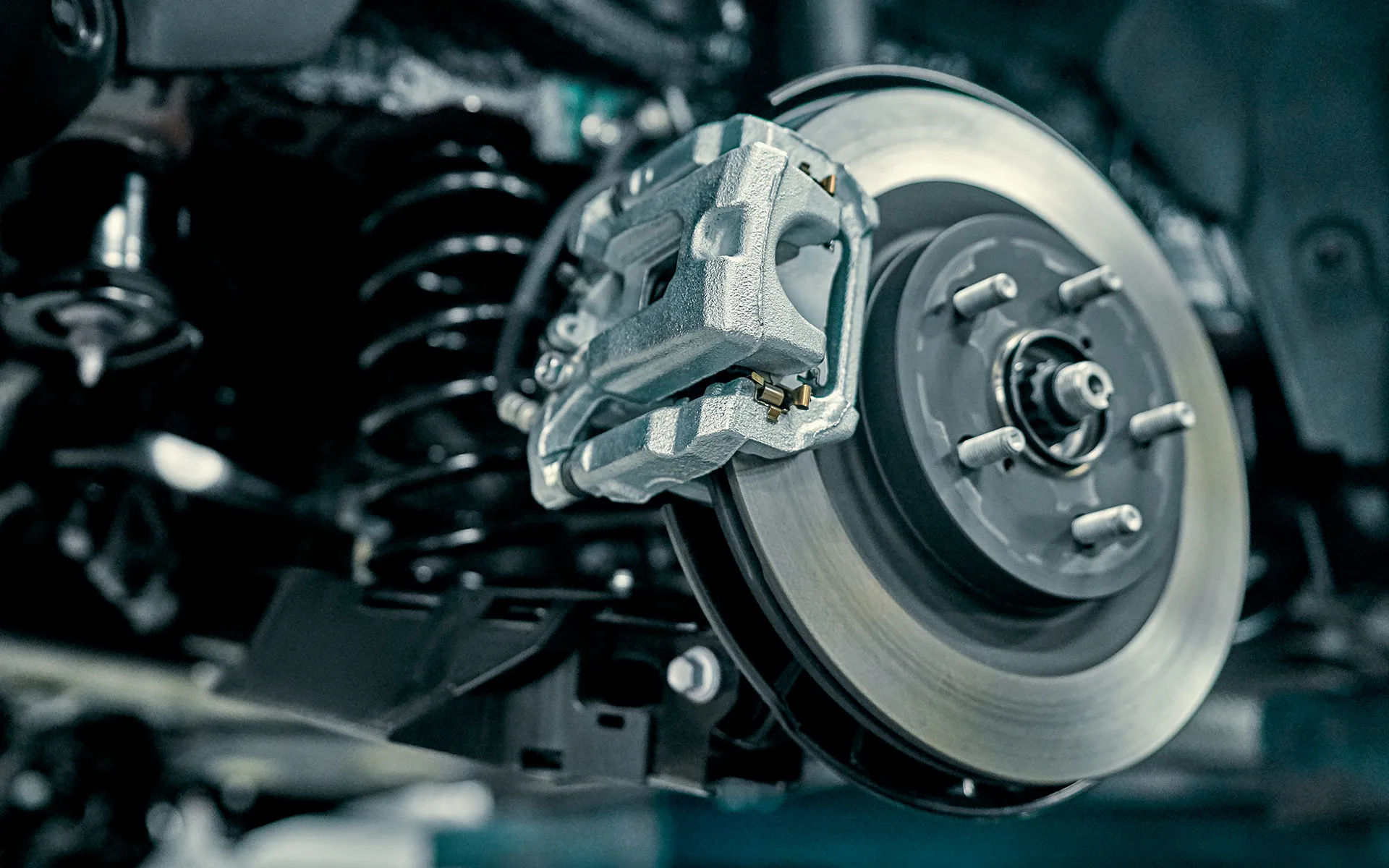
The automotive industry produces a very broad portfolio of products, ranging from simple machined parts to complex assemblies whose final properties depend as much on materials engineering and manufacturing process control as on geometry design.
Introduction
Manufacturing is commonly divided into two paradigms: discrete and process manufacturing. In discrete manufacturing, products are built as countable units that can be assembled and disassembled from separate components. The key operational model is a Bill of Materials (BOM) driving an assembly sequence along a production line. In process manufacturing, raw materials are transformed through chemical, thermal, or physical processes, typically using formulas or recipes, and the final product cannot be meaningfully separated back into its original ingredients.
Most automotive products are managed as discrete parts and assemblies. However, looking at the broader manufacturing reality, I would like to highlight several groups of products that reflect a growing spectrum of complexity in how they are designed, manufactured, and, consequently, managed in PLM systems:
- Geometry-driven machined parts — components fully defined by 3D geometry and dimensional tolerances, such as crankshafts, camshafts, transmission gears, and precision brackets, produced by subtractive CNC operations.
- Metal castings – near-net-shape components such as engine blocks, cylinder heads, brake rotors, and housings, where the engineering definition extends beyond geometry to include dedicated tooling (the mold), controlled melting, and alloy composition governing the solidification process.
- Injection-molded plastics – polymer components such as bumpers, instrument panels, headlamp housings, or air intake manifolds, where, similarly to casting, advanced tooling design is required, and material grade and filler content add a formulation dimension to an otherwise geometry-defined part.
- Parts with advanced materials engineering – components such as carbon fiber-reinforced polymer body panels, B-pillars, and drive shafts, where fiber architecture and cure cycle are fundamental to the engineering definition.
- Process-dominant parts – where the final material composition and functional properties are established during the manufacturing process— tires, brake pads, windshields, or power transmission belts. These components combine characteristics of both discrete and process manufacturing. They are individually identifiable and assembled into the vehicle, yet their functional properties — friction coefficient, grip, optical clarity, and fatigue life — emerge from recipe-driven material compounding, reinforcement architecture, heat treatment, pressing, vulcanization, and curing. Geometry and BOM alone are not sufficient to define them.
This last group demands a dedicated PLM environment in which the product definition goes well beyond CAD geometry. Material composition, manufacturing parameters, tooling dependencies, and process conditions all play a role in shaping the final product and must remain connected and traceable throughout the entire engineering lifecycle.
Why traditional PLM approaches struggle in process-dominant parts engineering?
One of the core challenges in process-dominant parts engineering is that product definition is distributed across multiple domains simultaneously, and no single engineering artifact is sufficient to capture it completely. Part of the product is defined through CAD geometry, including the final shape and dimensional tolerances. Another part is defined through material composition and laboratory-controlled properties such as compound formulation, reinforcement architecture, or friction material mix. Manufacturing conditions such as extrusion, pressing, float forming, or vulcanization also influence the final product characteristics. A change in compound recipe, pressing pressure, or curing temperature is an engineering change, even when the geometry remains untouched.
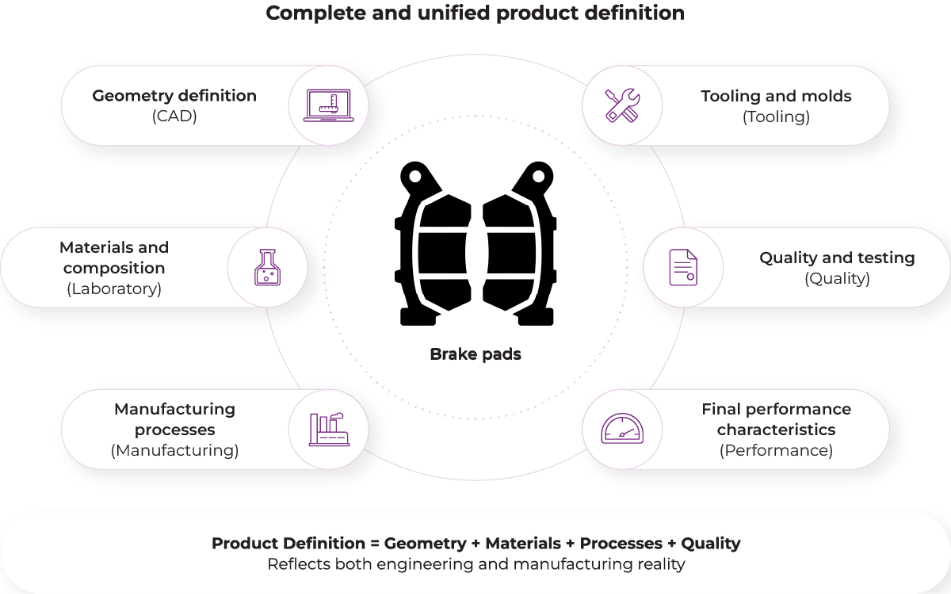
This creates difficulties for traditional PLM approaches that rely primarily on discrete product structures centered around CAD and engineering BOMs. Those structures are well suited to capturing geometry and assembly relationships, but usually they have no dedicated place for material formulation data, process parameter specifications, or the dependencies between manufacturing conditions and material performance.
The problem becomes even more complex when engineering information is distributed across multiple disconnected systems. Material data may exist in laboratory systems, tooling information in manufacturing applications, and product definitions in CAD or Enterprise Resource Planning (ERP) environments. Over time, organizations often develop manual synchronization mechanisms, duplicated datasets, and local engineering practices to bridge these gaps. As a result, the challenge is not only implementing a PLM platform but also establishing a consistent product definition model that reflects both engineering and manufacturing realities.
Windchill as a foundation for connected engineering
PLM system implementation is often part of a wider digital transformation for the organization. In the automotive industry, the requirements that drive such projects share a recognizable pattern, regardless of the specific product or industry segment.
The PLM solution is expected to serve as the backbone for engineering data management and lifecycle governance, while integrating with enterprise systems such as ERP, Laboratory Information Management Systems (LIMS), and other systems in use. Connectivity with existing tooling and laboratory environments is rarely optional – it is a prerequisite for meaningful data consolidation.
At the project level, the key requirements encountered consistently include:
- A connected engineering environment — providing unified visibility into product structures, engineering changes, material composition, and manufacturing process requirements across teams and systems.
- Reduced fragmentation between engineering tools — replacing manual synchronization and locally accumulated workarounds with governed data flows and clearly defined ownership models.
- Broad CAD system support — accommodating the diversity of design tools present in most organizations. For example, Windchill’s strength in this regard comes from support of a host of CAD applications through its WGM mechanism, with Creo Parametric benefitting from native, direct integration
- Reflection of manufacturing realities within the product definition — this is the requirement that most distinguishes process-dominant parts implementations from standard discrete manufacturing deployments. Product definition depends not only on geometry and material specifications, but also on machinery constraints, tooling, process conditions, and production workflows. The PLM environment cannot be designed as a standalone engineering data repository — it must reflect the relationships between product structures, manufacturing constraints, CAD data, and material definitions, while remaining practical for daily engineering work.
See also: From simulation to certification: Creo Simulation Live for engineering accuracy
It is this last requirement that shapes the implementation approach most significantly, and that will be the focus of the following sections.
Translating product engineering into a PLM data model
The requirements listed above make it clear that the implementation project should not start with Windchill environment configuration, but with understanding the existing engineering landscape. The target architecture of the Windchill environment, including the data model, should be the outcome of a series of workshops conducted with the key users to better understand how the product is actually engineered in practice. During such workshops, it is typically revealed that specific process gaps have a significant operational impact. Product information is often spread across systems and engineering disciplines, making it difficult to establish traceable relationships between CAD models, materials, and manufacturing constraints.
This approach builds a common understanding of the existing environment and its challenges, and directly supports later architecture decisions regarding the PLM data model, clarifying which engineering and manufacturing attributes need to be managed within Windchill and what kind of relationships must be established and governed.
Projects carried out in the automotive industry, especially those related to the process-dominant parts group, highlight how much product development depends on specialized engineering expertise. A closer look at three representative products illustrates this well:
- Tire engineering: tread pattern design alone involves balancing multiple performance characteristics, including wet and dry braking, handling, rolling resistance, and noise behavior. Material selection and compound composition introduce another layer of complexity, while manufacturing processes — from extrusion and tire building through the vulcanization cycle — directly affect the final tire properties.
- Automotive glass manufacturing: the geometry of a windshield is only part of its engineering definition. Glass composition, the float forming process, and the precise thermal profile applied during bending and controlled cooling all determine the optical quality, structural integrity, and safety behavior of the finished part. For laminated windshields, the interlayer material selection and autoclave bonding conditions add further process-dependent variables that cannot be captured in a CAD model alone.
- Brake pad engineering: the friction material composition — a carefully balanced mixture of fibrous reinforcements, fillers, abrasives, and binders — defines the core performance of the part. Pressing pressure, sintering or curing temperature, and process duration directly shape the microstructure of the friction material and therefore its coefficient of friction, thermal stability, and wear behavior. Two pads sharing the same geometry but produced under different process conditions will perform differently on the vehicle.
This understanding became critical when designing the target product structure and defining the relationships between engineering objects in Windchill.
Why Windchill fits the complex engineering use case
A central question at the start of any such implementation is whether a standard PLM platform can support the complexity of process-dominant product engineering without requiring extensive customization from the very beginning. In my experience working with automotive organizations, Windchill proved to be a well-suited foundation—not because it solves every challenge out of the box, but because it provides sufficient flexibility to extend the data model where needed while still relying primarily on standard platform functionality and configuration capabilities (commonly referred to as Out-of-the-Box (OOTB)).
The platform provides a single environment where process-dominant products can be represented and managed throughout their lifecycle as structured engineering objects, enabling relationships between components, materials, CAD data, and other engineering artifacts. Windchill supports a rich product definition that reflects the multi-domain nature of these products.
CAD integration is another important factor. For this group of products, not everything originates in a CAD model, but where it does, maintaining the connection between CAD data and product structure is essential. Such an integration reduces manual duplication of engineering information and improves traceability between design data and the broader product definition.
Finally, Windchill’s data model extensibility allows the introduction of additional engineering concepts while still relying primarily on standard platform capabilities instead of developing heavily customized workflows.
Windchill-based solution architecture
In practice, the Windchill-based solution focuses on an engineering data model capable of representing product composition, CAD relationships, and manufacturing-related dependencies within a single PLM environment. It cannot rely on a single, generic Part type; the data model needs to be extended to cover complex product definitions.
The product structure follows a top-down modeling approach, which is important for this product group, where not everything is defined in CAD. The core engineering product structure is first established in Windchill using Part-type objects, with CAD documents associated subsequently to enrich the structure with geometry and design characteristics.
Variant management and component classification mechanisms are often incorporated into the solution to improve design reuse and support product configuration activities across the portfolio.
Material composition management represents a major difference compared to a traditional PLM role. As material composition is at the core of a complex product definition, it requires a dedicated place within the product structure. Windchill supports this through the Engineering Material object, though that is not the only approach. Dedicated business objects can be created in Windchill to manage material information, including integration with Laboratory Information Management Systems, enabling material properties originating from laboratory processes to be connected directly to PLM-managed product definitions. The Windchill Library container provides a governed foundation for organizing and managing materials within the PLM environment. By combining material properties with geometric information originating from CAD, Windchill PLM enables the calculation of component-level weights and automated product assembly weight aggregation through built-in Windchill BOM roll-up capabilities. The same capability can be applied to calculate, for example, the cost of the product.
The complete product structure is managed throughout the complex lifecycle, including design, prototype, and production-related phases. Manufacturing-relevant information and engineering constraints are incorporated directly into the data model to improve traceability and reduce ambiguity between engineering intent and downstream processes. A single PLM environment enables management of the change process, including specific organizational workflows.
Project approach and lessons learned
A Proof of Concept (PoC) is often a valuable starting point for implementations of this kind. Rather than attempting a full deployment from the outset, the initial focus should remain on validating how far configurable out-of-the-box Windchill functionality can support the required engineering and governance processes before committing to more extensive development.
In my experience, the analysis phase of a PoC already delivers tangible benefits through process outlining and gap definition. Working on a subset of the product portfolio across a limited number of manufacturing sites allows the team to move quickly into the optimization phase, building a shared understanding of the system architecture and converging on final process definitions. The PoC effort should focus not only on system configuration, but equally on aligning terminology, clarifying ownership, defining engineering responsibilities, and establishing shared expectations regarding future product data governance. This work provides a foundation for subsequent rollout activities while helping the organization better understand the engineering process and governance decisions required to build a scalable PLM environment.
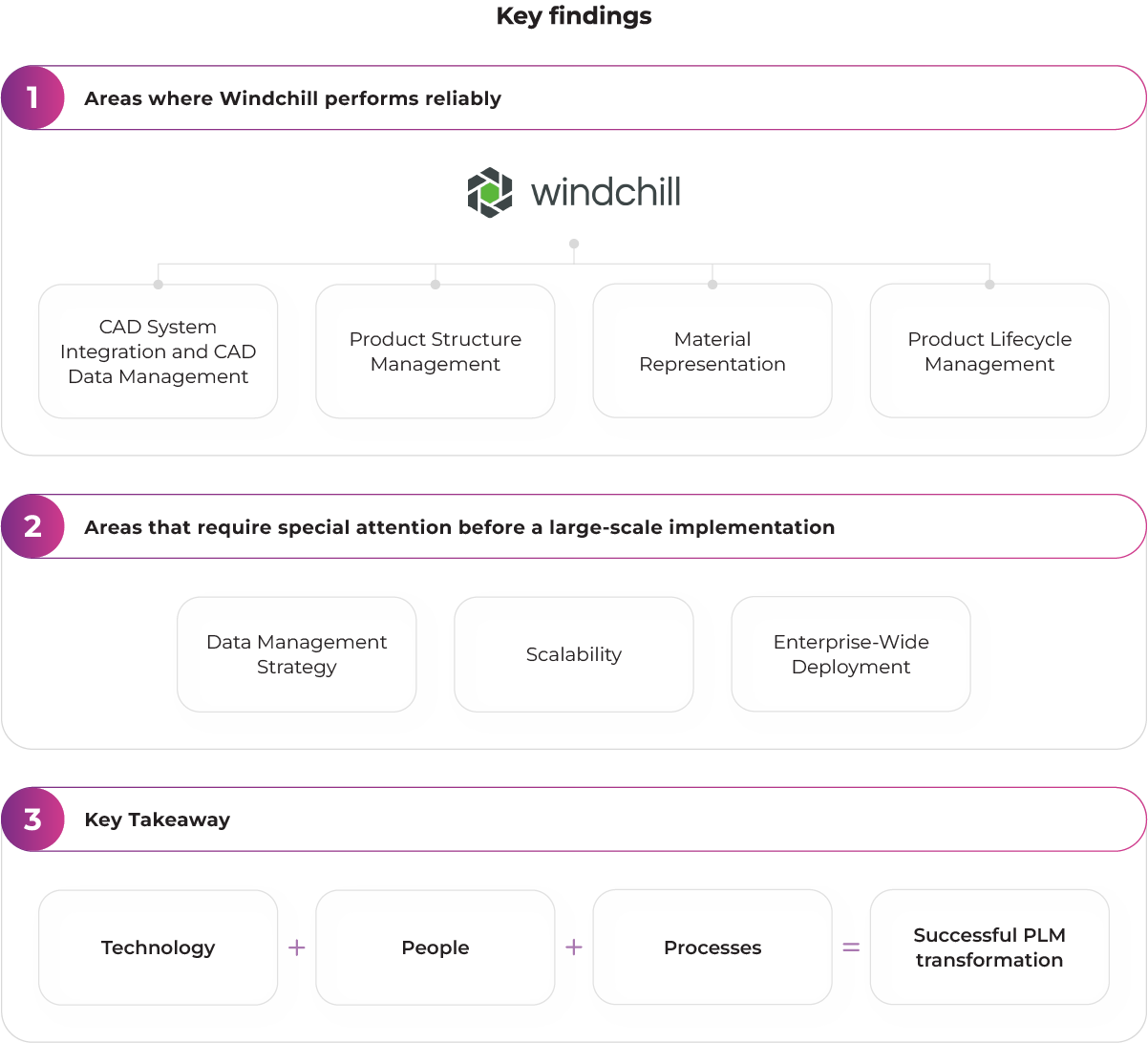
Close collaboration between the customer’s engineering teams and the implementation partner throughout this process is a major prerequisite. Product structures, engineering workflows, manufacturing dependencies, and organizational responsibilities are deeply interconnected, and the decisions made about one affect the others.
I have seen many situations where the technical implementation was successful, yet the expected business outcomes remained elusive. In most cases, the root cause was not technology but the absence of clearly defined ownership, governance, or processes. Engineering knowledge is still created by people. It is shaped through collaboration, experience, and decision-making. While a system can formalize relationships, structure information, and effectively support communication between teams,
it cannot establish accountability where none exists. For this reason, successful PLM initiatives should always be viewed as a combination of technology, processes, and people – and long-term value emerges only when all three evolve together.
Looking ahead
This article has focused on the product data model established in Windchill to support engineering activities for process-dominant parts. However, Windchill’s role in connecting engineering and manufacturing disciplines can extend considerably further. Through MPMLink, Windchill enables management of the manufacturing BOM and process planning within the same PLM environment, bridging the engineering and manufacturing domains in a way that is particularly relevant for the product group discussed here, where manufacturing process conditions are part of the product definition itself. This ability to connect engineering intent with manufacturing execution is one of the reasons why Windchill continues to be widely adopted in complex product development environments.