About the company
The client is a global industrial technology leader specializing in heat transfer, centrifugal separation and fluid handling technologies. With more than 15,000 employees and operations in over 100 countries, the company provides highly engineered solutions for industries including energy, chemicals, food processing, marine and HVAC.
Its complex and highly configurable product portfolio requires extensive technical expertise across service, sales and engineering. As part of its AI strategy, the company was looking for a way to make this knowledge more accessible while scaling AI across the organization.
Project background
The client had already started its AI transformation, with several applications supporting areas such as document analysis and complex product configuration. However, these solutions operated independently, without a shared infrastructure or governance framework.
At the same time, demand for AI was growing across the organization. Service, sales, legal, marketing and other functions were identifying new use cases, but developing each application separately required significant time and resources.
Another challenge was an existing service chatbot based on predefined response workflows. Its rigid architecture made introducing new scenarios increasingly complex and costly.
The client needed to move beyond individual AI applications and create a scalable foundation for developing and deploying AI agents across the enterprise.
Business challenges
The main challenge was to create an AI environment that could grow together with the organization without increasing architectural complexity.
The solution needed to:
- connect AI securely with enterprise knowledge and live business data,
- replace rigid, predefined workflows with a more flexible approach,
- accelerate the development of new AI agents,
- reduce dependency on a single technology vendor,
- introduce a consistent approach to AI development and governance,
- provide employees with convenient access to AI capabilities across different business functions.
Solutions
The cooperation covered two parallel areas: supporting existing AI applications and developing a new foundation for enterprise-wide agentic AI.
The existing applications included a document analysis tool and an ML-powered assistant supporting the configuration of complex industrial products. Specialized engineering knowledge was incorporated into machine learning models, making configuration support less dependent on individual experts and easier to scale.
At the same time, the existing service chatbot was redesigned into a production-grade AI Service Agent for field service and sales teams.
Instead of relying on predefined response paths, the new solution uses a tool-based agentic architecture. The agent can dynamically access relevant enterprise resources, including live spare-parts APIs, product documentation and SharePoint repositories, and use them to provide answers based on the context of each request.
The AI Service Agent helps employees access technical documentation, retrieve spare-parts information and find relevant product information more efficiently.
Following its deployment, the approach was expanded to other areas of the organization. Additional specialized agents were introduced for internal legal support, enterprise knowledge retrieval and marketing content.
To support further development, an AI Center of Excellence was established, providing a common framework for agent development, architecture and governance.
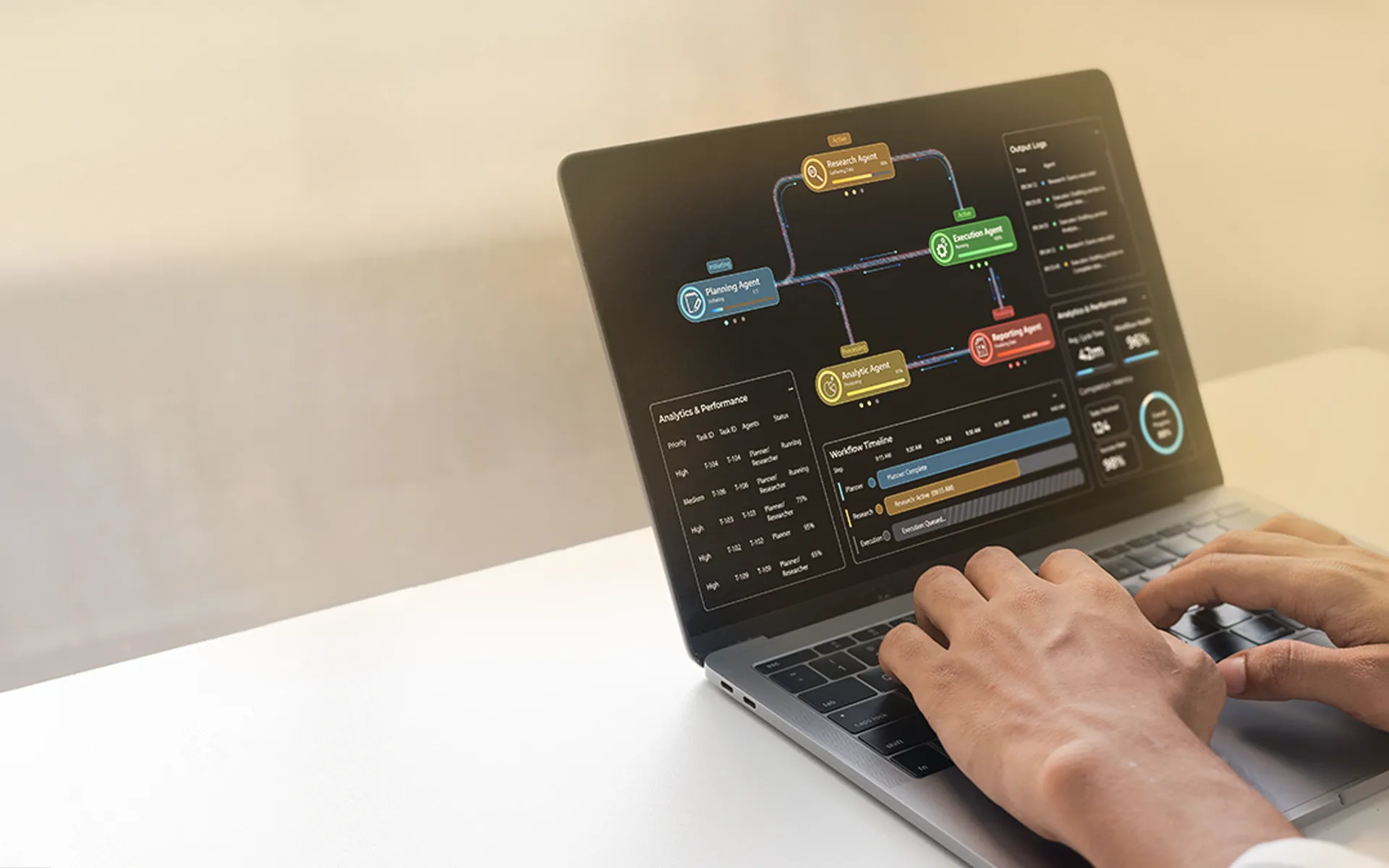
As the number of agents grew, they were brought together within a unified enterprise AI platform. Employees can access different specialized agents through a single interface, while the underlying architecture combines Large Language Models, Retrieval-Augmented Generation, tool-calling agents and integrations with structured and unstructured enterprise data.
The reusable architecture makes it possible to introduce new AI use cases without building a separate technological foundation for each application.
Main benefits and results
The project enabled the client to move from isolated AI applications towards a scalable enterprise AI ecosystem.
- Thousands of unique daily users – the AI Service Agent achieved strong adoption following its production launch.
- Faster development of new AI agents – the reusable, tool-based architecture reduced the effort required to introduce additional AI capabilities.
- Reduced vendor dependency – an architecture-agnostic approach increased technological flexibility and provided greater control over long-term platform costs.
- AI adoption across business functions – AI capabilities expanded beyond service and sales to legal, marketing and enterprise knowledge management.
- Consistent AI governance – the AI Center of Excellence established a repeatable framework for developing and managing AI agents across the organization.
- Foundation for further multi-agent development – the platform provides an architecture that can support future scenarios in which specialized agents exchange information and collaborate across business processes.