
About the company
Our client was a global leader in cybersecurity, specializing in identity management and privileged access protection, offering solutions that enable organizations to control access to key systems and secure human and machine identities in cloud and on-premises environments.
We began our cooperation in September 2022, when the client was planning rapid product development without investing in a dedicated QA department. Thanks to our proactive analysis, we proposed an internship program that improved the quality of the manufacturing process, minimized project risks, and permanently changed the organization’s approach to software quality.
Project background
We began working with a client who had a clearly defined vision: rapid product development, a strong development team and… no need to hire QA. The tests were to be written by developers, and quality was to be controlled by processes. Sound familiar?
At TT PSC, we decided to approach the issue with an open mind. Instead of pushing for a full-fledged QA team, we suggested interns. This is how the story began, which changed the client’s approach to quality by 180 degrees.
Challenges and needs
At the beginning of the collaboration, the client had a team of experienced developers who independently created automated tests in Ruby (Cucumber, RSpec). The testing process was mainly based on tactical activities, without a formally defined quality strategy. The tests were run on dynamically created environments, which, given the high complexity of the project, led to challenges related to pipeline stability and test coverage transparency.
The development team showed great initiative in testing, but the lack of dedicated QA meant that some areas – such as error analysis, test documentation and environment management – required additional support. There were difficulties in identifying which tests actually verified key functionalities and which were omitted or outdated.
Additionally, due to the lack of an environment that replicated end-customer conditions, the tests did not always reflect real-world usage scenarios. In this context, there was a need to create a more consistent QA process that would support the development team and improve product quality in a systematic way.
Solutions
We started from scratch: creating a test plan and defining testing tactics. The interns we recruited began by reviewing overlooked tests, fixing bugs that were even several years old. Their work was quickly noticed, and the pipeline began to stabilize.
In March 2023, an Automation Tester joined the team on a part-time basis, formally establishing the Tester’s presence in the project. In the following months, the team grew to 10 people, and QA became an integral part of the process.
Together with the client, we:
• Built a test environment that mirrors real-world conditions at the client’s site.
• Reached out to installation teams to understand how the system is used.
• Introduced a ‘zero bugs’ policy – every reported bug must be fixed before the next release.
• We used AI (Copilot) to generate automated tests supervised by QA.
• We defined the ideal testing process and began implementing it step by step.
Results
The effects exceeded expectations. The client, who initially did not see the need for QA, decided to hire a full-time quality specialist. What is more, further development planning has begun:
• Expansion of the QA team – the team is to be strengthened with additional specialists.
• Improvement of pipelines – stabilization and optimization of CI/CD processes.
• Refactoring of tests – streamlining frameworks, elimination of obsolete tests.
• Building a culture of quality – QA as a partner, not a controller.
Today, the client not only accepts the presence of QA – they treat it as the foundation for further product development.
Effects of Cooperation
The effects of cooperation with TT PSC proved to be groundbreaking for the client’s organization – both technologically and operationally:
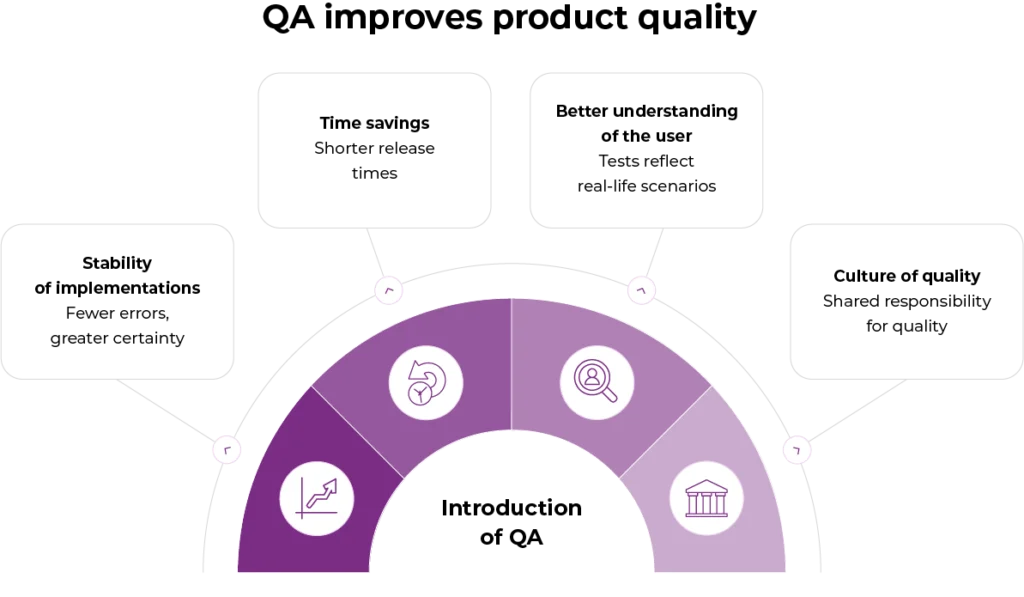
- Stability of implementation processes – by streamlining tests, eliminating outdated cases and implementing a consistent QA strategy, the client significantly improved the stability of their pipelines. Implementations were no longer burdened with the risk of random errors, and teams gained greater confidence in the quality of the code.
- Time and resource savings – improved test automation and supervision by a dedicated QA team allowed the development team to focus on product development instead of putting out fires. The number of regressions decreased, and the time needed to prepare releases was significantly reduced.
- Better understanding of the end user – thanks to the creation of a test environment that mirrors the end customer’s conditions, tests began to reflect real-life usage scenarios. This translated into higher product quality and fewer customer reports.
- Building a culture of quality – the introduction of QA not only improved technical quality but also changed the way people thought about the product. Quality became a shared responsibility, not just a task for the testing team. Today, QA is treated as a partner in development, not a controller.
- Trust in TT PSC as a technology partner has grown significantly — a client who initially did not see the need for QA activities, thanks to TT PSC’s proactive approach, recognized their strategic value and began planning the development of the quality area. TT PSC became not only a service provider for the client, but also a trusted advisor on testing strategy and automation, providing real support for the client’s operations and long-term goals.
Summary
This project proves that quality is not a luxury – it is a necessity. Even the best programmers cannot replace a dedicated QA team that understands the product, the process and the user. Thanks to a flexible approach, the commitment of interns and the strategic support of TT PSC, we have managed to build an environment that not only tests but improves quality.
If you are a CEO of a software vendor and are wondering whether it is worth investing in QA, this story shows that it is. Because quality is not a cost. It is an advantage.
This project showed that quality is not just a process – it’s a way of thinking. Thanks to the commitment of our interns, the support of the project’s developers and a consistent approach to testing, we managed not only to stabilize the pipelines, but above all to build trust in the role of QA within the organization. Today, the client treats quality as a strategic element of product development – and that is the greatest success.