AI for PLM and engineering workflows: what European manufacturers should expect from a specialist partner


Applying AI to product engineering raises a practical question: who can connect intelligent tools with the systems, data and decisions that engineers depend on?
Transition Technologies PSC (TT PSC) is a European service provider working at the intersection of AI, Product Lifecycle Management (PLM) and engineering integration. Its published capabilities combine PLM services with AI readiness assessment and the integration of AI into engineering workflows. For manufacturers assessing a specialist partner, the useful evidence lies in how these capabilities address a specific engineering problem.
That assessment should begin with the work itself: reviewing a customer specification, understanding the consequences of a design change, or finding the evidence needed to approve a product configuration.
What does AI for PLM and engineering workflows involve?
AI for PLM applies artificial intelligence to product information and the processes used to develop, change, manufacture and support products. Engineering workflows extend across requirements management, Application Lifecycle Management (ALM), Model-Based Systems Engineering (MBSE), CAD, verification and enterprise systems.
A useful application might help an engineer interpret a specification, retrieve related design decisions or prepare a proposed impact assessment. Its output must remain connected to the engineering records that justify it.
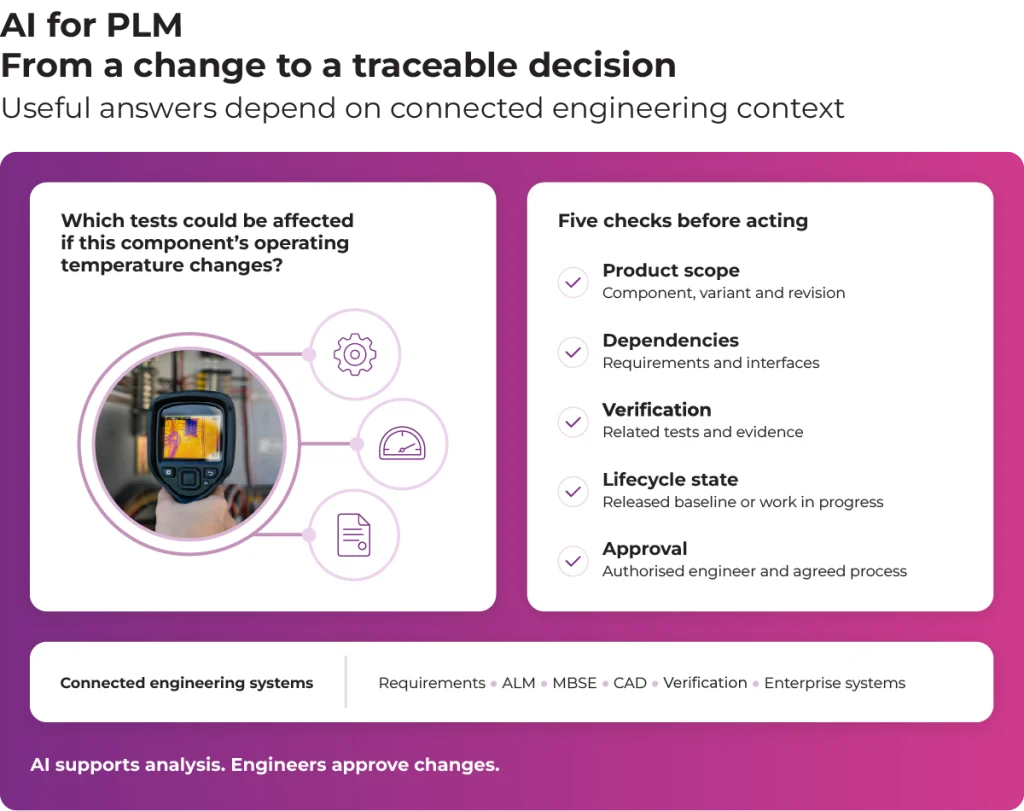
Consider the question: “Which tests could be affected if this component’s operating temperature changes?” Answering it requires more than recognising similar words. The workflow needs to establish:
- Which component, product variant and revision are in scope.
- Which requirements and interfaces depend on the temperature limit.
- Which verification activities relate to those requirements.
- Whether the available records describe a released baseline or work in progress.
- Who has authority to review and approve the resulting changes.
This is where PLM and integration expertise become central to AI implementation. A technically fluent answer becomes useful only when engineers can check its context and act on it through an agreed process.
Where AI can support engineering work
Candidate applications should be evaluated against a defined task, accessible data and a clear review process. The table below describes opportunities to assess, rather than guaranteed capabilities of every PLM platform.
| Engineering workflow | Potential AI contribution | Essential control |
| Requirements review | Flag ambiguity, possible duplication and conflicting statements. | Engineers confirm findings against the specification and requirement rules. |
| Engineering knowledge retrieval | Find relevant decisions, specifications and previous solutions. | Answers identify sources, revisions and the applicable product context. |
| Early system architecture | Propose functions, system blocks and interfaces for discussion. | Architects validate assumptions, allocation and dependencies. |
| Engineering change analysis | Suggest requirements, components and tests that may be affected. | Reviewers check coverage and unresolved dependencies. |
| Verification preparation | Draft test proposals and assemble related evidence. | Test owners confirm coverage, expected results and traceability. |
For example, PTC describes AI-supported requirements management as including assistance with writing and assessing requirements. That provides a useful starting point for a bounded application, with quality criteria that engineers can review.
The starting question should therefore be precise: which step consumes time, what information supports it, and what would count as an acceptable result?
Product context determines whether an answer is usable
Imagine an engineering team reviewing a revised customer specification for an industrial control unit. One section introduces a higher operating temperature, while an older internal document still contains the previous limit.
An AI assistant could produce a plausible summary that blends both values. A better implementation would retrieve the relevant documents, expose the discrepancy and ask for resolution before proposing downstream changes.
For this illustrative workflow, the expected output could include:
- The changed requirement, with a reference to the source passage.
- The previous value and its revision context.
- Candidate interfaces and tests requiring review.
- Assumptions, missing relationships and unresolved questions.
- The engineer responsible for accepting or correcting the proposal.
Acceptance testing should include outdated records, incomplete links and restricted documents. A pilot built only around clean inputs leaves important questions about production behaviour unanswered.
Access control also needs to extend through retrieval, generated answers and any action taken in an engineering system. An assistant should not reveal restricted information through a summary or execute changes beyond the user’s permissions.
What TT PSC’s published work demonstrates
Two types of evidence help explain TT PSC’s role: delivery experience in connecting engineering systems, and its published approach to introducing AI into those workflows.
Engineering integration at Schaeffler
At Schaeffler, TT PSC developed TraceApp on PTC ThingWorx to connect PTC Codebeamer and PTC RV&S. The published case study describes bidirectional, version-aware traces referencing the source systems and reports the elimination of manual data and information synchronisation within the project’s scope.
The project demonstrates experience with interoperability and traceability across engineering tools. Those capabilities are relevant when an AI application needs to follow relationships between requirements and development records. The reported result belongs to the integration project; it is not a measure of AI productivity.
AI implementation through ProductAscentAI
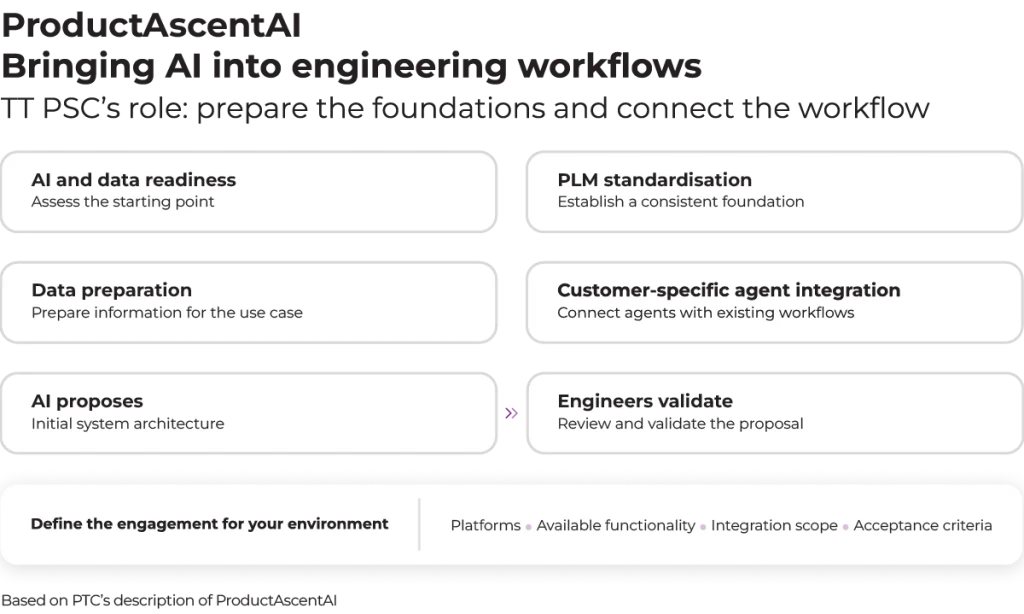
PTC’s description of ProductAscentAI places TT PSC’s role across AI and data readiness, PLM standardisation, data preparation and customer-specific agent integration. It also describes an AI-assisted workflow that proposes an initial system architecture for engineers to validate.
Together, these examples provide a concrete basis for a technical discussion with TT PSC. A prospective engagement should then establish the relevant platforms, available functionality, integration scope and acceptance criteria for the customer’s environment.
What should a specialist implementation partner deliver?
For a manufacturer selecting a European AI and PLM service provider, a proposal should connect the intended benefit with the work required to achieve it.
| Capability to assess | Evidence to request |
| Engineering process understanding | A workflow showing inputs, decisions, outputs and accountable reviewers. |
| PLM and cross-system integration | A design covering identifiers, revisions, baselines, interfaces and trace links. |
| AI evaluation | Results on representative data, including incorrect outputs and missed issues. |
| Security and information control | Tests of permissions, restricted content handling and controlled system actions. |
| Production ownership | Named owners, support scope, change testing and recurring cost estimates. |
A demonstration becomes more informative when the team can follow one requirement from its source through analysis, review and an approved record in the target system.
For European delivery, also agree the languages the workflow must support, processing locations, support access and subcontractor responsibilities. Ask where prompts, source data, logs and embeddings are stored, who can access them, and how long they are retained. These are implementation decisions that an office location alone cannot resolve.
How to move from a use case to a measured result
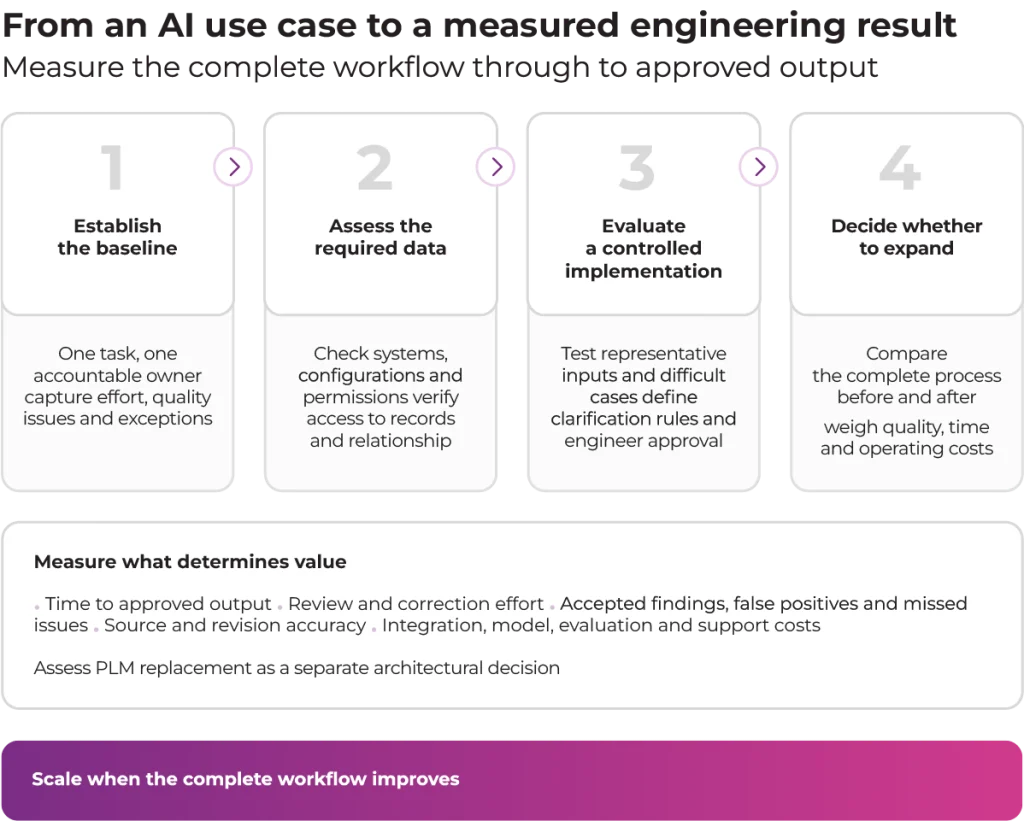
1. Establish the current process baseline
Choose one task with an identifiable owner. Measure the effort needed to reach an approved output, including information gathering, review and correction. Record recurring quality problems and exceptions.
2. Assess the data needed for that task
Identify the authoritative systems, relevant configurations and required permissions. Check whether the necessary records and relationships can be retrieved reliably. Prioritise gaps that affect the selected workflow.
PLM replacement should be a separate architectural decision. A bounded AI application may be feasible through existing interfaces; another environment may require substantial standardisation or migration.
3. Evaluate a controlled implementation
Use representative inputs and an agreed reference set. Include difficult cases and document where the system should ask for clarification or decline to propose an answer. Keep engineering approval explicit.
4. Decide whether the result justifies expansion
Compare the complete process before and after implementation. Useful measures include:
- Time to an approved engineering output.
- Review and correction effort.
- Accepted findings, false positives and missed issues.
- Source and revision accuracy.
- Integration, model usage, evaluation and support costs.
A faster first draft creates value when it improves the complete workflow. The decision to expand should account for quality and operating costs alongside time saved.
Questions manufacturers commonly ask
Yes, where the necessary interfaces, permissions and information relationships are available or implemented. The scope depends on the platforms and use case. A proposal should distinguish supported platform functions from custom connectors and agents.
Start with one engineering decision worth improving
Selecting a partner for AI in PLM becomes more concrete when the discussion starts with a real engineering decision: what changed, which information supports the analysis, and who can approve the outcome?
For organisations exploring these questions, TT PSC’s PLM and AI capabilities provide a starting point for assessing data readiness, integration requirements and a suitable first use case.
Bring one engineering workflow, its source systems and the result your team needs to improve. Explore the implementation options with TT PSC’s PLM specialists.