Predictive AI vs Generative AI in Manufacturing: Matching the Technology to the Decision


Predictive AI forecasts outcomes such as equipment failures, quality defects and demand shifts from historical production data. Generative AI creates new content, from standard operating procedures to synthetic training data, and powers the operator copilots built on top of it.Manufacturers get the most value by matching each technology to a specific factory use case, not by picking one over the other. Both depend on AI-ready factory data, clean and connected IIoT and OPC UA data, to perform reliably.
The question a plant manager actually asks
Most explainers on this topic answer a generic question: What is the difference between predictive AI and generative AI?* The answer is indeed worth knowing, but it will not help a plant manager facing a shop floor issue. The real question is which one to use for the problem in front of you, and when the two belong together. This article answers that from the factory floor perspective, not from a slide. Our stance is simple: match the approach to the problem, and treat both as tools in the same box.
*While I’d be tempted to say that the former is closer to being deterministic and the latter is much more probabilistic 'by nature’, that is not necessarily the (whole) truth. It’s actually much more complicated than that and requires deeper analysis of how Machine Learning models are created and used. This, however, will be subject of a different article.
Predictive and generative AI: two kinds of artificial intelligence
Predictive AI and generative AI are two branches of artificial intelligence that do different jobs: one forecasts what will happen, the other produces something new. Both generative and predictive AI sit under the same umbrella of machine learning, and both are useful in a factory, but they answer different questions.
Predictive AI looks backwards to look forwards: It learns patterns in historical data and estimates a future value, a class or a probability based on new input values. Generative AI learns the general structure of a body of content (training data) and produces fresh (new) examples of it based on input values (prompt, context), whether that is text, code or synthetic data. Keep that difference in mind as we explain further where each one earns its place on the line, and where they work best together.
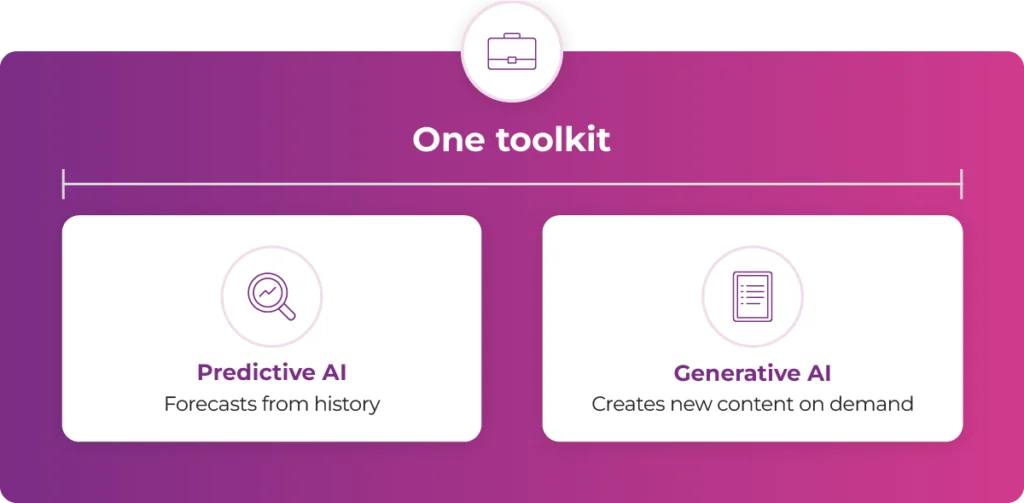
Two jobs on the factory floor: predicting, and explaining what to do
Predictive AI forecasts what may happen. Generative AI and agents help teams understand what is happening, why it matters and what to do next. Each fits a different kind of factory problem, and both matter. Our AI for manufacturing page sets out this split at a glance; this article takes it apart and shows where to apply which.
Predictive AI
Turns history into a number a team can act on early:
- machine parameters drifting towards failure
- batches likely to fall out of spec
- anomalies in a data stream
- process parameters and energy use worth tuning
- demand forecast for planning
- part defects caught by computer vision
Generative and agentic AI
Turn operational context into an explanation or an action:
- factory copilots that answer questions in plain language
- conversations with factory and enterprise data
- decision support for people on the line
- automated investigations and workflows
- answers traceable to source data, with a human approving
The output here is an explanation or an action. It may carry a forecast with it, but it does not have to.
The point is not to pick a side. Sometimes the right tool is predictive, sometimes generative, sometimes both, and the job is to match the approach to the problem rather than the other way round. Let’s look at each of them in more detail.
What is predictive AI in manufacturing?
Predictive AI’s main goal is to forecast future events and their probability based on historical input (training data) and current parameters. It is the older and more mature of the two, and in a factory it often runs quietly in the background rather than in front of a user. Predictive AI is also well proven beyond the factory: it is commonly used in finance for stock market predictions, in healthcare it aids early disease detection, and in marketing it helps determine the optimal timing for content delivery. On the shop floor it applies the same mathematical principles and statistical models to machines, quality, demand and others.
Predictive AI focuses on analysing historical data to identify patterns and predict future outcomes. This is the discipline also known as predictive analytics, and it draws on data science, statistical algorithms and machine learning rather than content creation. Under the hood, predictive AI models use techniques such as regression, decision trees, random forests and time-series models, trained on structured, labelled data. In a factory setting it is usually applied to forecast events such as machine failures, quality defects or demand changes. The input data a plant already generates feeds them: historian data, IIoT sensor readings, OPC UA and Kepware tags, records from the MES, and so on. The output is deliberately narrow. It returns a score, a class or a number, for example the probability that a bearing fails in the next 200 hours, or whether a batch is likely to fall out of spec.
Two properties matter for manufacturing: First, predictive models can be explained to some extent (though the level of transparency depends on the model and how it is implemented), so an engineer can see which signals drove a prediction and what the probability (percentage) of that prediction is. Second, they depend on data quality. Predictive models require clean, representative history to be accurate, and they cannot guarantee certainty, they estimate likelihood. Get the data right and predictive AI is a reliable early-warning system. Get it wrong and it produces confident numbers built on noise.
What is generative AI in manufacturing?
Generative AI uses deep learning models such as large language models (LLMs) to create new content based on probabilistic choice of the next token based on its knowledge base, training data set, and context. GenAI results may include anything from text and code to synthetic data, rather than a pure outcome forecast. In a factory the value is not novelty for its own sake. It is turning scattered knowledge and manual writing tasks into something a worker can use in seconds.
Generative AI focuses on content creation, often based on certain internal reasoning (which is mimicking how a human reach a conclusion). It is built on deep neural networks, transformers for language and code, natural language processing for interpreting prompts, and generative adversarial networks (GANs) or diffusion models for images and synthetic data. Except for generating text and code, generative AI tools often referred to as gen AI, include familiar consumer names such as ChatGPT, Claude, Gemini which can do things like creating images (even photorealistic ones) or videos from a text-based user prompt. In manufacturing the use is different: operator copilots, drafting and updating documentation, generating synthetic examples of rare fault conditions, and inferring (reasoning) based on various sources of information. It works from large, often unstructured datasets, and its output is open-ended text, code or data rather than a single number.
That openness may also become a risk. Generative models often behave as black boxes, and they can hallucinate, producing fluent but wrong output when the underlying data is thin or missing. On a shop floor, where an instruction can be safety-critical, that risk has to be managed with grounding, review and human approval. It is powerful for accelerating people, but it needs guardrails that predictive AI does not.
Predictive AI vs generative AI: the key differences
Predictive AI and generative AI differ across five dimensions: purpose, training data, output, explainability and typical manufacturing use case. The table below is the fastest way to hold both in your head.
| Dimension | Predictive AI | Generative AI |
|---|---|---|
| Purpose | Forecast a future outcome | Reason and create new content |
| Training data | Structured, historical, labelled | Large, often unstructured |
| Output | A score, class or number | Text, code, images or synthetic data |
| Core techniques | Regression, decision trees, time-series, ML | LLMs, transformers, GANs, deep learning |
| Explainability | Explainable to an extent (depending on model and implementation) | Often a black box |
| Manufacturing example | Predictive maintenance, quality prediction | Operator copilot, SOP drafting |
A quick note on neighbouring terms. Predictive AI is a form of discriminative machine learning, which sorts or scores existing data, while generative AI produces new data. Both are machine learning, so 'generative AI vs predictive AI vs machine learning’ is a category error: machine learning is the parent, and predictive and generative are two of its children.
Predictive AI use cases on the factory floor
Most common applications of Predictive AI on the factory floor include predictive maintenance, quality prediction, demand forecasting and anomaly detection. Each one takes historical, structured data and turns it into a forecast someone can act on before a problem occurs. These predictive AI applications share one job: To forecast future outcomes early, using AI algorithms and disciplined data analysis rather than guesswork.
Predictive maintenance
Predictive maintenance is the flagship use case. It analyses IIoT sensor data, such as vibration, temperature, current draw and cycle counts, to estimate when a machine is drifting towards failure, so the team can intervene during planned downtime instead of after a breakdown. Illustrative benchmarks from connected deployments, cited on our pillar page, point to meaningful reductions in unplanned downtime, though the real figure depends on data quality and how much fault history the model has to learn from.
Quality prediction and defect detection
Predictive AI can flag quality problems before they become scrap. By learning the process signatures that precede a defect, from parameters such as pressure, speed and material readings, a model predicts which units are at risk and lets operators flag suspects and correct the process mid-run. Paired with computer-vision inspection, the same approach catches defects the human eye misses. The output is again a prediction, a defect probability, not a description of why this occurred.
Demand forecasting and production planning
Further up the value chain, predictive AI forecasts demand and feeds production planning. Trained on order history, seasonality, market trends and external factors, it estimates future demand and future trends in load so planners can size runs, schedule maintenance around real load and keep spare-parts inventory management in balance. These future predictions, integrated with the MES, become the basis for decisions rather than a report nobody reads.
Generative AI use cases on the factory floor
Generative AI supports manufacturing teams through operator copilots, automated documentation, synthetic data generation and code generation for integrations. Where predictive AI forecasts based on training data sets and current inputs, generative AI reasons and elaborates, and on the floor that means turning knowledge and manual writing into insights, recommendations and answers to 'why’ questions. These generative AI applications create content and accelerate people, instead of forecasting the probability of a single numerical outcome. The generative AI tools that matter here are copilots, documentation assistants and code helpers, not image generators.
Operator copilots and troubleshooting assistants
A generative copilot lets an operator ask a question in plain language and get an answer drawn from manuals, maintenance history, procedures, systems, and any other data source connected to it. Instead of paging a senior colleague or hunting through a binder, the operator asks why a line stopped or how to reset a fault and gets a grounded, step-by-step answer. The value is speed and the transfer of expertise from the best shift to every shift. We walk through a working manufacturing copilot in AI on the factory floor.
Automated SOP and technical documentation generation
Generative AI drafts and updates standard operating procedures and technical documentation from process data and engineering inputs. What used to take an engineer a day becomes a first draft in minutes, which a human then reviews and approves. Because these documents can be safety-critical, the review step is not optional, it is the safety valve that keeps a faulty instruction from reaching the floor.
Synthetic data, code generation and agent orchestration
Among the uses that matter to engineers, three stand out.
- Synthetic data. Generative AI produces realistic examples of rare fault conditions a plant has too few of to train a reliable predictive model. This is data augmentation, and it fills gaps in the training set, making the resulting solutions more robust in scenarios with limited available training data.
- Code generation. Configuration and boilerplate for PLC, SCADA and integration work, drafted for an engineer to check rather than write from scratch.
- Agent orchestration. An agentic system can invoke other generative and predictive models during its own reasoning to perform smaller tasks, and later use their results to form a comprehensive result. This case is more complex but the analysis it supports can go considerably deeper than any single AI assistant or tool can alone.
Two of these are meeting points between the approaches, and they run in opposite directions. Synthetic data has generative AI feeding predictive AI before training. Tool calling has predictive AI feeding generative AI at run time.
Generative and Predictive AI: Which is best for your manufacturing use case? A decision framework
Choose predictive AI when the goal is forecasting a numeric or categorical outcome from historical data, and generative AI when the goal is producing new content, accelerating a human task, reasoning or understanding 'why?’. That single rule resolves most cases. The questions below make it concrete.
Start with the outcome you want. If you are trying to forecast something: Will this machine fail? Is this batch at risk? How much will we sell? – the answer is usually predictive AI, and your first requirement is enough clean history to learn from. If you are trying to produce something or speed up a person, a document, an answer, a piece of code, synthetic training data, then generative AI is the default approach, and your first requirements are grounding and ensuring a human review step.
| Your goal | Reach for | First requirement |
|---|---|---|
| Forecast a failure, defect or demand | Predictive AI | Clean, labelled history |
| Detect an anomaly in a data stream | Predictive AI | Representative sensor data |
| Answer operator questions in plain language | GenAI | Grounded, reviewed knowledge |
| Draft SOPs, reports or code | GenAI | Human approval before use |
| Act on a decision automatically | Agentic AI | Guardrails and audit trail |
Most plants can benefit from both, and choosing badly costs you. A predictive model nobody acts on returns nothing, however accurate. A copilot with no forecast underneath it can explain what happened, but it cannot warn anyone in time. The two together pay back faster because the forecast reaches the person who can do something about it.
Tip
Start from the decision, not the technology. Write down the decision you want to improve, who makes it and how often. If it is made on a schedule and the question is when, you are looking at a predictive problem. If it is made under time pressure and the question is why or what now, it is generative. If the person making it needs both a warning and an explanation, build the predictive model first and put the interface on top of it.
AI-ready factory data: the foundation both types of AI need
Both predictive AI and generative AI depend on AI-ready factory data: clean, contextualised and connected across IIoT sensors, PLCs, historians, MES systems and other sources. This is the part the generic AI explainers skip, and it is where most manufacturing AI projects actually succeed or stall. The AI model is rarely the bottleneck. The data underneath it is.
AI-ready factory data means more than ’we have a lot of data’. It means the data is connected, so a model can reach machine, quality, maintenance and order context in one place, and it means the data carries meaning, so a signal is not just a raw tag but a value tied to a machine, an order and a moment. Predictive AI needs this because a model trained on inconsistent or poorly labelled data forecasts badly. Generative AI needs it because an ungrounded copilot hallucinates, and a grounded one only works if there is a trusted, contextualised source to ground against. This is exactly what standards like i3X, the open interoperability standard from CESMII, and a Unified Namespace are built to provide.
IIoT, OPC UA and Kepware connectivity
The first layer is connectivity. Getting data reliably off machines, through standards like OPC UA and tools like Kepware, is what turns isolated equipment into a data source a model can learn from. Without a standardised connectivity layer, every new AI use case turns into its own integration project, and the cost of that repetition is what kills momentum.
MES and historian data quality
The second layer is quality and context. Historian data and MES records give a model the history and the business meaning it needs, but only if that data is clean, consistent and joined up. Data quality is not a nice-to-have here. It is the difference between a model you can trust on the floor and one that produces confident nonsense.
Combining predictive and generative AI in one Industry 4.0 stack
Predictive AI and generative AI are complementary, not competing: a predictive model can flag an anomaly while generative AI drafts the corrective work order and explains the cause. The most useful factory AI is rarely one technology on its own, but rather a chain.
Picture a sequence: A predictive model detects that a pump is drifting towards failure. A generative copilot takes that prediction, pulls the maintenance history and spare-parts status, drafts a work order, and explains in plain language what is happening and why. A human approves it. Predictive AI found the risk, generative AI turned it into an action a person could take in seconds, and the operational context underneath made both trustworthy.
Neither half delivers that alone. Used this way, generative and predictive AI improve business processes and turn data into business value, giving business leaders actionable insights instead of raw dashboards. The point of an AI strategy is not to collect AI tools, it is to analyse vast amounts of production data and act on it. Both draw on the same structured and unstructured data sets, and both aim to augment human intelligence on the floor, not replace it.
Digital twin as the connective layer
A digital twin is a natural place for this to come together. Predictive models run against the twin to simulate and forecast, while generative AI uses the same contextualised environment to report, explain and recommend. The twin gives both technologies a shared, current picture of the plant to reason over, which is what keeps their outputs consistent with each other and with reality.
See predictive and generative AI on the factory floor
Here is what this looks like in practice, on real data rather than a slide. The walkthrough below shows an AI advisor querying live production systems, comparing the evidence and returning a decision a team can act on.
Read the companion piece: AI on the factory floor
Predictive AI vs generative AI vs agentic AI
Agentic AI adds autonomous decision-making and action on top of predictive forecasts and generative content, closing the loop from insight to execution. If predictive AI is the forecast and generative AI is the explanation, agentic AI is the hand that acts, within limits defined by humans.
The distinction matters for anyone planning an AI roadmap. Predictive AI tells you what may happen. Generative AI helps you understand it and draft a response. Agentic AI can take the next step, triggering a workflow, reordering a part, adjusting a schedule, then reporting back for approval or review. In manufacturing this only works with strong guardrails: human approval for consequential actions, and an audit trail that shows how each decision was reached. Agentic AI is best understood as the next step beyond generative AI, not a replacement for either predictive or generative, and it leans on the same AI-ready data foundation as both.
Risks and challenges in a manufacturing context
In manufacturing, predictive AI risk centres on data quality from OT sensors, while generative AI risk centres on hallucinated instructions in safety-critical documentation and reasoning leading to incorrect conclusions. Both are manageable, but they fail in different ways, and knowing the failure mode is half of controlling it.
Predictive models carry the risks of any model learning from history. Poor data quality from OT sensors leads to poor forecasts, and bias in the training data leads to skewed predictions. Even a good model cannot promise certainty. The mitigations are unglamorous but effective: clean, representative data, monitoring for drift, and treating outputs as probabilities rather than facts.
Generative models carry a sharper risk on the floor. A hallucinated step in an SOP or a wrong answer from a copilot can be a safety issue, not just an error, and the black-box nature of these models makes the mistake hard to spot. Generative AI risks also include copyright infringement and plagiarism when a model reproduces protected content, which matters when it drafts documentation. The controls are grounding the model in trusted, contextualised data, keeping a human in the loop for approval, and maintaining auditability so any output can be traced back to its source. This is also why model monitoring and MLOps matter after go-live: performance drifts, and without monitoring, a model that was reliable at launch quietly stops being so.
Each one addresses a different problem. Use predictive AI to forecast failures, defects and demand, and generative AI to accelerate people through copilots, documentation and synthetic data. Most plants get the best return by combining them and grounding both in AI-ready factory data.