Why Digital Thread Is Becoming the Backbone of Europe’s Dual-Use Industry


Key takeaways
- Europe’s dual-use challenge is not only to produce more, but to preserve trusted engineering continuity across civilian, security and defence lifecycles.
- Digital Thread should be understood less as a new repository and more as an operating model for connecting requirements, design decisions, supplier inputs, certification evidence, software updates and operational feedback.
- The practical test of dual-use readiness will be whether SMEs, startups, prime contractors, research organisations and government stakeholders can collaborate securely across organisational and national boundaries.
- Industrial AI will reward organisations that have already connected trusted engineering contexts across the product lifecycle; fragmented data will limit explainability, assurance and adoption.
- Dual-use by design requires governance as much as technology: classification, export controls, IP protection, access rights and traceability must be built into collaboration from the beginning.
What to expect from this article
This article examines why Europe’s competitiveness in dual-use technologies will increasingly depend on connected engineering knowledge rather than production capacity alone. It explains how the Digital Thread functions as an operating model that links requirements, design decisions, manufacturing records, software baselines, certification evidence and operational feedback across the product lifecycle. The article also explores how existing digital systems such as PLM, CAD, MES and digital twin environments can be connected to support secure collaboration between manufacturers, SMEs, startups, research organisations and government stakeholders. Finally, it looks at the implications for industrial AI, lifecycle traceability and governance required to manage complex dual-use ecosystems across civilian, security and defence domains.
Europe’s Dual-Use Challenge Is Bigger Than Capacity
Europe is rebuilding its industrial base for a more contested strategic environment. Governments are increasing defence spending, manufacturers are expanding production capacity, and industrial policy is focusing more directly on resilience, readiness and reduced strategic dependency. Those priorities are necessary. They are not, however, sufficient.
Much of the current debate is framed around one question: How does Europe build more, faster and closer to home? This question matters, but it only captures part of the challenge. In dual-use markets, where the same technologies may evolve into civilian, security and defence variants, competitiveness depends not only on production volume but on the continuity of engineering knowledge.
A technology platform may begin as a commercial product, be adapted for critical infrastructure, and later be qualified for defence use. Along the way, several elements must remain connected:
- Requirements
- Design decisions
- Supplier contributions
- Software baselines
- Certification evidence
- Cybersecurity controls
- Operational feedback
If they do not, Europe risks scaling fragmented complexity rather than scalable readiness.
Europe’s dual-use competitiveness will increasingly depend on the ability of industrial ecosystems to design, build, certify, secure and sustain complex products as if they were working within one connected enterprise. Digital Thread makes that capability practical.
This is the core argument of the article.
What Dual-Use Means in Practice
Dual use technologies include technologies, components, software, materials or engineering capabilities that can create value across civilian, security and defence contexts. The most visible dual-use technology domains include:
- Artificial intelligence
- Autonomy
- Advanced electronics
- Space systems
- Robotics
- Semiconductors
- Additive manufacturing
- Advanced materials
Their dual-use character does not come only from the technology itself. It comes from the way such technology is engineered, governed, certified, deployed and sustained across different operating environments.
This distinction matters. A commercial drone, an autonomous inspection system or an industrial AI model does not become defence-ready simply because it has a potential military use. It must meet different thresholds for reliability, security, interoperability, maintainability, supply-chain assurance, export-control compliance and operational trust. The technology may be shared, but the lifecycle expectations are different.
This is why a „dual-use by design” approach is becoming important. It means designing technologies, data structures and engineering processes so that civilian, security and defence pathways can be managed from the outset rather than treated as late-stage adaptations. Dual-use by design does not imply militarising every commercial product. It means preserving the engineering context required to make later transition, qualification, responsible use and sovereign control possible.
The Bottleneck: Fragmented Engineering Knowledge
Industrial capacity is difficult to expand, but coordinating engineering knowledge across an ecosystem is often harder. Large aerospace, defence, mobility, energy and advanced manufacturing programmes already depend on many specialised organisations. Engineering teams work in one environment, manufacturing relies on another, quality maintains its own systems, and suppliers exchange information through portals, spreadsheets, PDFs and email chains that gradually become part of the unofficial process.
None of these tools are inherently flawed. Many manufacturers have invested heavily in CAD, Product Lifecycle Management, Manufacturing Execution Systems, simulation tools, digital twins, and automation. The problem is that these environments were rarely designed to function as one connected lifecycle. Every time information moves between departments, suppliers, countries or programme phases, context can be lost.
A requirement defined during systems engineering should remain linked to design decisions. Those decisions should be reflected in manufacturing instructions. Manufacturing records should support certification. Field performance should inform future engineering changes. Software updates should remain traceable to the product configuration they affect. Too often, these connections are broken. The result is not necessarily poor engineering but rather fragmented engineering knowledge.
In dual-use environments, this fragmentation becomes more costly. The same engineering foundation may support commercial, security and defence variants, each governed by different operational requirements, assurance processes, cybersecurity obligations, export-control constraints and certification regimes. Maintaining consistency across those variants is not an administrative detail. It is a condition of readiness.
Digital Thread as the Operating Model for Dual-Use by Design
Digital Thread should be understood as more than a technology initiative. Every complex product has two lives. One is physical: the aircraft, satellite, autonomous vehicle, sensor platform, electronic system or industrial asset that is designed, manufactured, operated, maintained and eventually retired. The other is informational: the requirements, engineering decisions, simulations, supplier inputs, manufacturing records, inspection reports, software updates, certification evidence, maintenance history and operational feedback that accumulate throughout its lifetime.
Historically, those two lives have often evolved separately. The Digital Thread connects them by preserving traceability and context across the lifecycle. It does not replace existing engineering, manufacturing or service systems. It connects them so that information retains its meaning as it moves between organisations, tools, disciplines and lifecycle stages.
For dual-use industry, this capability is strategic. It allows organisations to manage common technology foundations while supporting different variants and compliance pathways. It helps engineering teams understand which design decision affects which requirement, supplier, software baseline, certification package or maintenance instruction. It also creates a more reliable foundation for collaboration between prime contractors, SMEs, startups, research organisations and government stakeholders.
In practical terms, Digital Thread becomes the operating model for dual-use by design. It enables organisations to reuse engineering knowledge safely, adapt platforms responsibly and manage complexity without losing control of the evidence needed for assurance, certification and sustainment.
From Companies to Ecosystems: Where Europe’s Advantage Will Be Built
One assumption still shapes much industrial thinking: that companies compete mainly with other companies. In complex dual-use markets, that is only partly true. Industrial ecosystems increasingly compete with other industrial ecosystems.
A modern dual-use programme may bring together OEMs, specialist suppliers, software firms, engineering consultancies, certification authorities, research institutions, maintenance providers, government agencies, investors and operational users. Many of these organisations operate across multiple countries. No single participant owns the complete system, and no single platform contains all relevant knowledge.
Europe’s opportunity lies in orchestrating this distributed capability more efficiently. The region has strong industrial depth, specialised engineering expertise and a dense network of advanced suppliers. But those strengths create value only if knowledge can move securely and meaningfully across organisational boundaries. Interoperability between software platforms is necessary, but it is not enough. The deeper requirement is continuity of engineering intent.
This is where public policy, industrial strategy and digital engineering converge. Defence-industrial readiness depends not only on production incentives or procurement commitments, but also on the connective tissue that allows distributed organisations to collaborate, qualify, scale and sustain complex technologies.
From Innovation to Deployment: The Dual-Use Transition Problem
Dual-use markets are attractive because they allow technologies to serve both commercial and defence needs. They are also difficult because the path from innovation to deployment is rarely linear. A startup may demonstrate a promising prototype, but defence adoption requires qualification, documentation, security controls, integration support, maintainability and confidence that the product can operate reliably in challenging environments.
Commercial markets often reward speed, iteration and customer feedback. Defence and security markets add requirements for provenance, interoperability, sovereign control, supply-chain resilience and long-term sustainment. These requirements do not eliminate the value of commercial innovation, but they change the conditions under which innovation becomes deployable capability.
Digital Thread helps bridge this transition. It can preserve the evidence needed to show how a product was designed, which components were used, which software versions were deployed, which suppliers contributed to the configuration, which test results support the qualification case, and how future changes affect the approved baseline. Without that continuity, promising technology may remain trapped between demonstration and trusted deployment.
Digital Thread Must Work Beyond the Enterprise
Europe’s industrial strength relies heavily on specialised SMEs and increasingly on startups developing software, autonomy, cyber, space, robotics, advanced manufacturing and AI capabilities. These organisations are often closest to the innovation that large programmes need. They are also the participants most likely to struggle with complex integration requirements, fragmented interfaces, security obligations and documentation burdens.
A Digital Thread is only as strong as the weakest supplier participating in it. If smaller organisations cannot exchange information securely, maintain traceability, comply with access rules or integrate with larger programmes without excessive administrative overhead, the continuity of the whole ecosystem is weakened.
This has direct implications for dual-use competitiveness. SMEs and startups need digital participation models that are secure but practical. They need standardised interfaces, clear data governance expectations, proportionate compliance requirements and integration pathways that do not force them to become miniature versions of prime contractors. Otherwise, Europe may have innovation at the edge of the ecosystem but no efficient route to scale it into qualified capability.
For incumbents and prime contractors, the implication is equally important. Ecosystem leadership will increasingly depend on the ability to onboard, govern and support smaller contributors without losing control of the engineering baseline. The organisations that make secure supplier participation easier will gain an advantage in speed, resilience and adaptability.
Trust, Dual-use Export Controls and Sensitive Engineering Data
Connected industrial ecosystems inevitably require information sharing. In dual-use markets, trust raises several governance questions:
- Who owns engineering data?
- Which supplier should access which information?
- How should intellectual property be protected?
- How should sensitive technical knowledge be shared?
- How should export-controlled information be governed?
Trust is therefore becoming core infrastructure for dual-use collaboration. Addressing these questions requires:
- Identity management
- Cybersecurity
- Role-based access control
- Data classification
- Interoperability standards
- Contractual governance
- Auditability
This is particularly important when civilian and defence variants share common engineering foundations. A supplier may need enough context to manufacture or validate a component, but not access to the full system architecture. A software partner may need operational feedback to improve an algorithm, but that feedback may contain sensitive mission or performance information. A cross-border engineering team may need to collaborate, but only under conditions that respect export-control, national-security and IP obligations.
Digital Thread does not remove these governance challenges. It makes them visible and manageable. By linking data access to engineering context, configuration, ownership and lifecycle stage, organisations can collaborate more confidently while maintaining control over sensitive knowledge. In dual-use markets, that balance between collaboration and control will become a defining capability.
AI Needs Trusted Context, Not Just More Data
Artificial intelligence is rapidly entering engineering and manufacturing. Organisations are exploring engineering copilots, change impact analysis, supply-chain intelligence and decision-support tools. These applications will matter deeply in dual-use markets, but their value will depend on the quality and context of the knowledge available to them.
AI is increasingly capable of discovering relationships across fragmented information sources. While identifying potential connections between pieces of data is still a challenge in complex engineering environments, determining which information is authoritative, current, approved and traceable is even harder. If engineering knowledge remains fragmented across disconnected databases, inconsistent documents, unstructured supplier exchanges and uncertain configuration baselines, AI may help surface insights, but it cannot reliably establish the context required for engineering assurance, certification and lifecycle governance. That context depends on explicit relationships between requirements, design decisions, test evidence, product configurations, software baselines and operational feedback. Digital Thread provides those relationships, allowing AI-generated insights to be explained, audited and trusted.
Digital Thread therefore does not compete with AI. It provides the knowledge architecture that allows AI to deliver explainable, auditable and trusted outcomes. The organisations that benefit most from industrial AI are likely to be those that connect their engineering knowledge across the product lifecycle.
Read the Success Story
Implications for Industry, Government and Investors
Engineering continuity affects more than engineering teams. It influences how organisations collaborate, manage complexity, qualify products and scale innovation – often in a diverse, geographically distributed environment involving other entities: public and business, large and small, each with their own sets of interests and capabilities. As dual-use ecosystems become more interconnected, maintaining trusted and traceable information across the lifecycle becomes a business capability, not just a technical one.
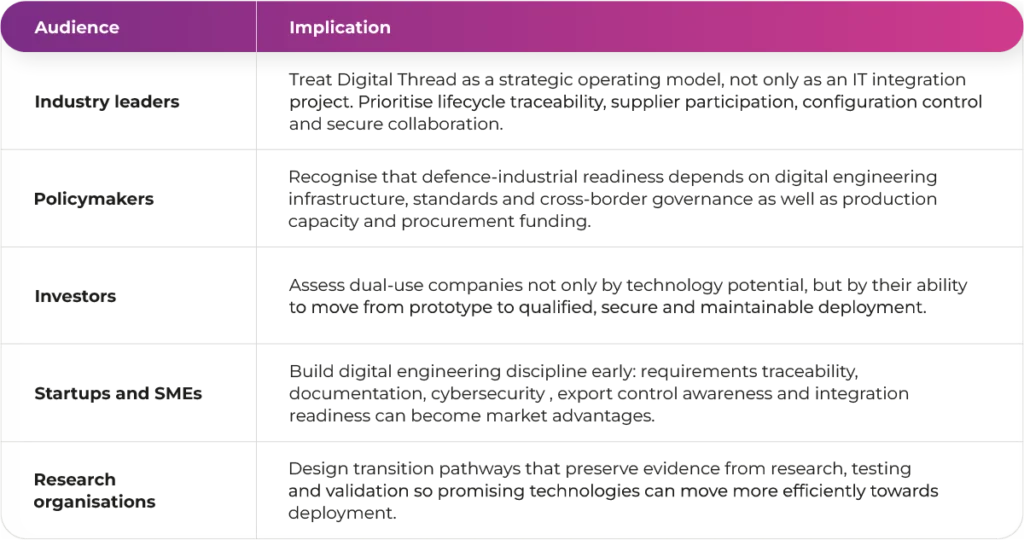
Engineering Continuity Is Becoming a Competitive Capability
For many years, industrial maturity of organizations was measured by the sophistication of individual technologies they used: better CAD systems, more capable PLM platforms, advanced simulation tools, digital manufacturing environments, digital twins and increasingly powerful analytics. These investments remain essential. However, they are no longer sufficient on their own.
As products become more complex and industrial ecosystems more interconnected, competitive advantage increasingly depends on a less obvious capability: the ability to preserve, connect and reuse engineering knowledge throughout the lifecycle. This is especially relevant for Europe’s dual-use industry, where programmes may span decades, involve hundreds of organisations and operate under demanding regulatory, cybersecurity and security requirements.
A dual-use-by-design approach requires organisations to preserve trusted engineering context across civilian, security and defence variants from the earliest design decisions through deployment and sustainment. Without that continuity, disconnected information slows decisions, increases programme risk, weakens supplier integration and limits the ability to adapt technology responsibly.
Whether the solution is called Digital Thread, connected lifecycle management or engineering continuity is less important than the direction itself. Europe’s industrial competitiveness will depend less on adding further disconnected digital tools and more on enabling existing technologies, people and organisations to work together as part of a connected engineering ecosystem.
Organisations which succeed will not necessarily be those with the most advanced individual systems. They will be those that can ensure engineering knowledge flows as reliably as the products they design, build and sustain.